

Best Rugged Phone for Construction Workers in 2026: What to Look For and Which Models Hold Up
A smartphone on a construction site takes more punishment in a week than most phones face in a year. Concrete dust finds its way into every gap. Phones get set down on wet surfaces, dropped from scaffolding, exposed to rain, and left in direct sun for hours. Battery life runs out mid-shift at the worst possible moment.
Most consumer phones aren't designed for this. Even "durable" consumer devices with basic water resistance don't hold up to sustained exposure to construction environments. Rugged phones — a category built specifically around durability standards — exist precisely for this use case.
This guide covers what specifications actually matter for construction site use, which features are worth paying for, and which phones in 2026 are worth considering.
What Construction Workers Actually Need From a Phone
Before looking at specific devices, it's worth being specific about what construction site conditions demand.
Dust and water resistance that goes beyond casual protection
Construction sites generate concrete dust, silica particles, sawdust, and debris that standard dust-resistant ratings don't address. IP68 is the most commonly cited water resistance rating, covering submersion to 2 meters for 30 minutes — sufficient for rain, puddles, and accidental drops in water. IP69K adds high-pressure, high-temperature water jet resistance, which matters when equipment is being hosed down nearby or when working in environments that get pressure-washed regularly. For construction use, a phone that carries both IP68 and IP69K provides more complete protection than IP68 alone.
Drop protection rated to real-world heights
Drops from waist height to concrete are the most common failure scenario for job site phones. MIL-STD-810H is the US military's standard for equipment durability, covering drops, vibration, temperature extremes, humidity, and altitude. Drop protection certified to 1.5 or 2 meters is the relevant benchmark for construction use. Phones without explicit drop certifications often fail this test despite marketing as "tough."
Battery that lasts a full shift — or can be replaced mid-shift
A 10–12 hour shift with continuous GPS use, calls, and camera use will drain most smartphones before the end of the day. Options for managing this include a large battery (5,000mAh+), battery-saving features, or — in a smaller number of rugged phones — a physically replaceable battery that can be swapped mid-shift without powering the device off. The latter approach eliminates battery anxiety entirely if the worker carries a spare.
Glove-friendly controls and readable display
Most touchscreens are unresponsive with work gloves. Rugged phones designed for field use typically support glove mode and often include programmable physical side buttons for common functions. Outdoor readability — a display bright enough to read in direct sunlight — is similarly basic but often overlooked in consumer-oriented specs.
Loud, clear audio for noisy environments
Job sites are loud. A phone with a high-decibel loudspeaker and noise-filtering microphones makes a meaningful practical difference when taking calls near equipment or in open-air environments.
Key Certifications Explained
IP68: Sealed against dust ingress and can be submerged in up to 1.5–2 meters of water for 30 minutes. The specific depth and duration depend on the manufacturer's declared rating. Protects against rain, splashes, and accidental drops in water.
IP69K: Withstands high-pressure water jets (80 bar) at close range and elevated temperature. Originally developed for agricultural and industrial equipment that gets pressure-washed. Less common than IP68; the combination of both provides comprehensive water and dust protection across different exposure scenarios.
MIL-STD-810H: A US Department of Defense test standard covering 29 environmental conditions including drop, vibration, humidity, salt fog, altitude, and temperature shock. Devices that pass this standard have been tested — not just claimed — to withstand these conditions. The H revision is the current and most comprehensive version.
Gorilla Glass: Corning's impact-resistant glass used for screen protection. Different generations offer different levels of scratch and impact resistance. For construction use, Gorilla Glass 3 or higher provides meaningful scratch resistance against the abrasive materials common on job sites.
Features Worth Prioritizing
Worth prioritizing for construction use:
- IP68 + IP69K dual rating (not just IP68)
- MIL-STD-810H certification with explicit drop height stated
- Replaceable battery or 5,000mAh+ capacity
- Physical side buttons for glove-friendly operation
- 230+ lumen flashlight (a practical job site tool beyond standard phone use)
- Loud speaker with noise cancellation on calls
Situation-dependent:
- 5G (4G LTE is sufficient for most job site communication; rural construction sites often have better 4G than 5G coverage)
- Thermal imaging (valuable for inspection and electrical work specifically, not for general construction labor)
- AMOLED vs IPS LCD display (both work outdoors; AMOLED offers better contrast but isn't essential)
Rugged Phones Worth Considering for Construction in 2026
RugOne Xever 8
The Xever 8 is built around a specific problem: battery interruption during active field work. Its Swappable Battery 2.0 system allows the battery to be physically replaced while the phone remains fully operational — calls stay connected, GPS stays active, and running apps aren't paused. The phone ships with two 4,800mAh batteries and a 4-in-1 charging station so the spare charges while the device is in use.
On the durability side, the Xever 8 carries IP68 and IP69K dual water resistance, MIL-STD-810H certification, and a 2-meter drop rating. The dual-latch battery cover reinforces the chassis at the point most commonly impacted in a drop. A 230-lumen TorchX flashlight is accessible from a programmable side button.
The camera uses a 64MP Sony IMX682 main sensor and a 20MP night vision camera with IR sensors, covering documentation needs in both daylight and low-light conditions. It runs Android 16 with committed major OS updates through Android 19.
At 320g with a 6.5-inch screen, the Xever 8 is slightly more compact than the Xever 7 series, which makes it easier to handle in work gloves or carry in a chest pocket under PPE.
RugOne Xever 7
The Xever 7 is a 5G rugged phone with a 5,550mAh hot-swappable battery — a larger capacity per charge than the Xever 8 — and a more versatile camera system. The main camera is a 50MP OIS unit; the secondary is a 50MP ultra-wide with a 117.3° field of view, which provides broader coverage for photographing large work areas, site overviews, or progress documentation where spatial context matters. Night vision uses a 64MP sensor with four integrated IR lights.
The display is a 6.67-inch AMOLED at 120Hz. Storage is 12GB RAM and 512GB internal, expandable to 2TB. Durability specs match the Xever 8: IP68, IP69K, MIL-STD-810H, 2-meter drop protection.
Priced at $529.99, the Xever 7 is the right choice for construction workers who want 5G connectivity or prefer a larger battery per charge over zero-interruption swapping.
RugOne Xever 7 Pro
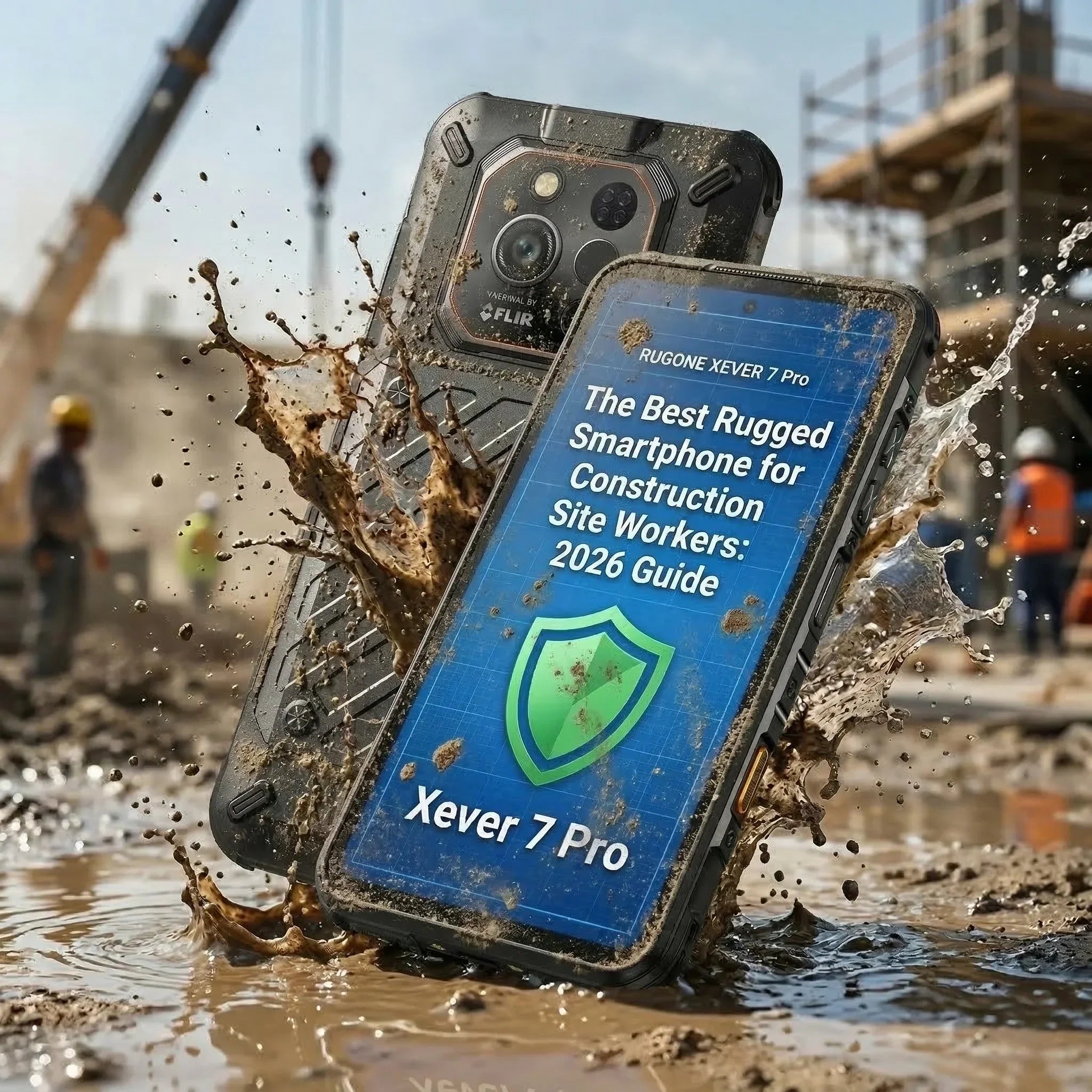
The Xever 7 Pro uses the same hardware platform as the Xever 7 but integrates a FLIR Lepton 3.5 thermal imaging sensor in place of the ultra-wide camera. For workers in inspection-adjacent construction roles — electrical contractors, building envelope specialists, HVAC installers — thermal imaging provides a diagnostic capability that would otherwise require a separate device. The sensor detects heat anomalies in electrical panels, moisture intrusion behind walls, and insulation gaps.
Priced at $659.99, the Xever 7 Pro is the most specialized of the three and most relevant to workers whose role includes any form of inspection or diagnostics alongside general construction work.
Side-by-Side Comparison
| Xever 8 | Xever 7 | Xever 7 Pro | |
|---|---|---|---|
| Price | $529.99 | $659.99 | |
| Battery | 4,800mAh × 2, Swap 2.0 | 5,550mAh × 2, hot-swap | 5,550mAh × 2, hot-swap |
| Battery swap | Zero interruption | Brief pause | Brief pause |
| Network | 4G + eSIM | 5G + eSIM | 5G + eSIM |
| Display | 6.5" IPS LCD 120Hz | 6.67" AMOLED 120Hz | 6.67" AMOLED 120Hz |
| Main camera | 64MP Sony IMX682 | 50MP OIS AI | 50MP OIS AI |
| Extra camera | 20MP night vision | 50MP ultra-wide | FLIR Lepton 3.5 thermal |
| Flashlight | 230-lumen TorchX | 230-lumen TorchX | 230-lumen TorchX |
| Drop rating | 2m MIL-STD-810H | 2m MIL-STD-810H | 2m MIL-STD-810H |
| Water rating | IP68 + IP69K | IP68 + IP69K | IP68 + IP69K |
| Weight | 320g | 325g | 325g |
| Android | 16 → 19 | 15 → 18 | 15 → 18 |
How to Choose for Your Role
General construction labor, site supervision, logistics on-site: The Xever 8 covers the core requirements — full protection credentials, all-day battery with zero-interruption swapping, good documentation camera, and a flashlight that functions as an actual work tool. The 4G network is sufficient for most job site communication.
Foremen or site managers who need 5G and more storage: The Xever 7 at $529.99 adds 5G, a larger battery per charge, more RAM and storage, and a wide-angle camera useful for site overview photography.
Electrical contractors, building inspectors, or HVAC workers on-site: The Xever 7 Pro's thermal camera provides a directly useful diagnostic tool for inspection work, at $659.99.
Summary
For construction site use in 2026, the baseline requirements are IP68/IP69K water resistance, documented MIL-STD-810H drop protection to at least 1.5 meters, and a battery strategy that covers a full 10–12 hour shift. A physical flashlight above 200 lumens and glove-compatible controls are practical additions that matter more in construction environments than in general consumer use.
The RugOne Xever 8, Xever 7, and Xever 7 Pro all meet those baseline requirements. The differences — battery swap behavior, network generation, camera configuration — map to specific role requirements within the construction industry rather than representing a clear hierarchy of overall quality.
View the Xever 8 → View the Xever 7 → View the Xever 7 Pro →
Related reading:
Xever 7 vs Xever 7 Pro vs Xever 8: Which RugOne Phone Should You Buy in 2026?
FLIR Thermal Camera on a Rugged Phone: What Thermal Imaging Actually Does in the Field