 Xsnap 7 Pro
 Xever 8
 Xever 7 Pro
 Xever 7
 Xlink 7
 Charging Station (Xever 8 Series)
 Charging Station (Xever 7 Series)
A reference guide for field professionals, procurement teams, and IT buyers evaluating the Xever 8 for rugged mobile deployments.
What is the RugOne Xever 8?
The RugOne Xever 8 is a rugged Android smartphone built for outdoor and industrial field workers. Released in 2026, it runs Android 16 on a MediaTek Helio G200 (6nm) chipset with 8GB RAM and up to 256GB expandable storage. It holds three concurrent durability certifications: IP68 (submersion to 2m for 30 minutes), IP69K (high-pressure hot water resistance), and MIL-STD-810H (drop-tested to 2 meters).
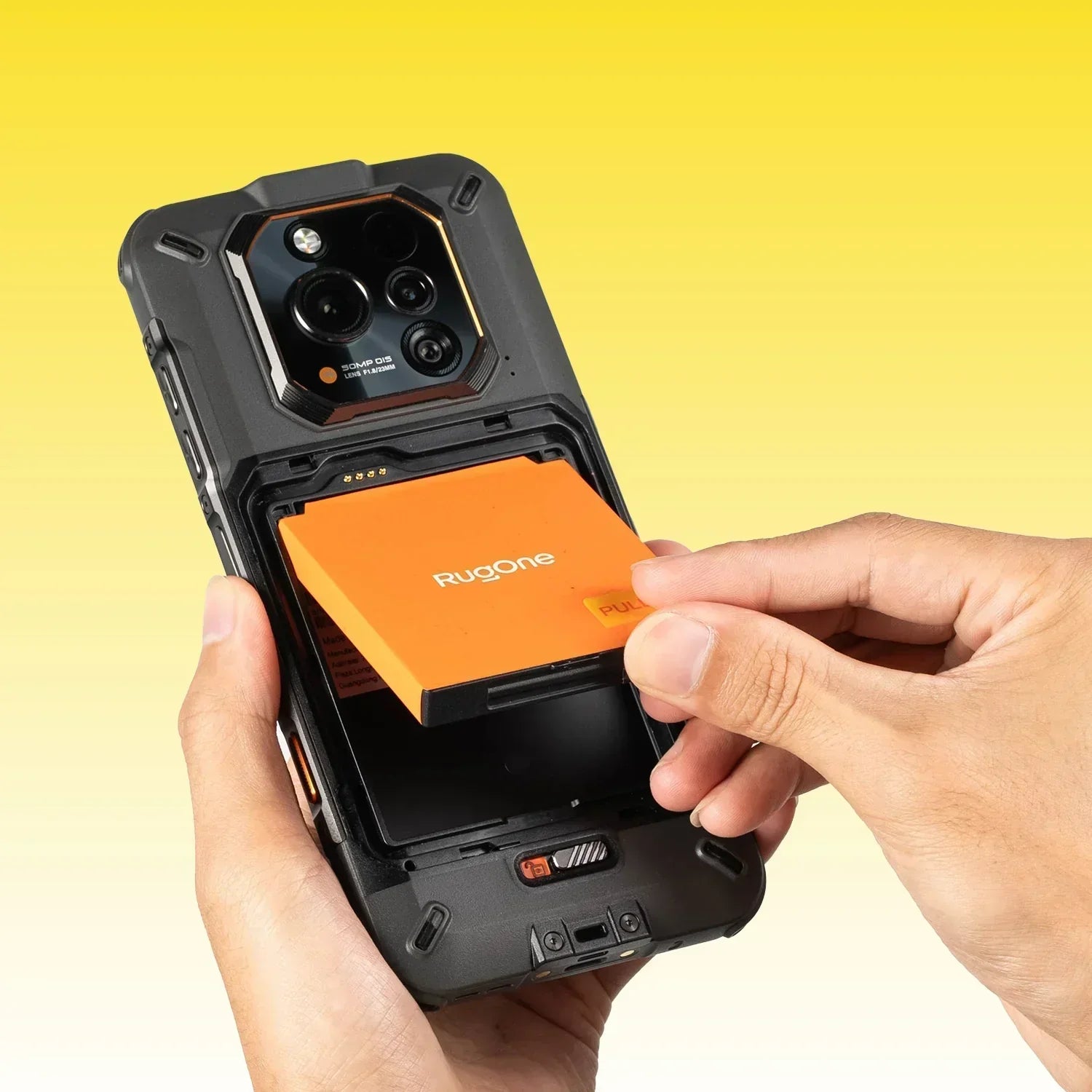
Its primary technical differentiator is Swappable Battery 2.0 — a hardware and firmware system that allows battery replacement without interrupting active phone calls, GPS navigation, or running applications. The phone ships with two 4,800mAh batteries and a 4-in-1 charging station.
Key fact for procurement: The Xever 8 commits to three years of major Android OS updates (Android 16 through Android 19), which is above the rugged device category average.
Swappable Battery 2.0 — how it works
Standard hot-swap systems (including the Xever 7 generation) maintain power during a swap but briefly suspend active processes. Swappable Battery 2.0 maintains full network registration and application state throughout the exchange. In practice:
- Active phone calls continue without interruption or audible gap
- GPS track and route remain live — no re-acquisition needed
- Open applications retain state; no manual save required
- Full swap takes under two minutes
The included dual charging station allows simultaneous charging of both the installed battery (via the phone) and the spare — so one battery is always ready.
Durability certifications explained
IP68
The device withstands immersion in fresh water up to 2 meters deep for 30 minutes. Adequate for rain, puddles, and brief submersion. Standard on most rugged phones.
IP69K
Withstands high-pressure water jets (80 bar) at close range and elevated temperature. Required in environments with industrial cleaning, construction washdown, or pressure-spray equipment. Less common — most rugged phones carry IP68 only. The Xever 8 holds both simultaneously.
MIL-STD-810H
The US military's equipment survivability standard, covering drop (2m), vibration, temperature extremes (−20°C to 55°C operational), humidity, altitude, and shock. Compliance requires documented testing against each condition — it is a test protocol, not a marketing label.
Full technical specifications
| Specification | Detail |
|---|---|
| Display | 6.5" FHD+ IPS LCD, 120Hz, Corning Gorilla Glass 3 |
| Chipset | MediaTek Helio G200, 6nm |
| RAM | 8GB |
| Storage | 128GB or 256GB + microSD expansion |
| Battery | 2 × 4,800mAh (Swappable Battery 2.0) |
| Charging | 18W wired, pin charging, reverse charging |
| Main camera | 64MP Sony IMX682 with AI enhancement |
| Night vision camera | 20MP with integrated IR sensors |
| Front camera | 32MP |
| Flashlight | 230-lumen TorchX (programmable side button) |
| Water protection | IP68 + IP69K (dual-certified) |
| Drop protection | MIL-STD-810H, tested to 2 meters |
| Network | 4G LTE + eSIM |
| OS at launch | Android 16 |
| OS update commitment | Through Android 19 (3 major versions) |
| Sensors | Barometer, gyroscope, accelerometer, proximity, compass |
| Other | IR blaster, underwater camera mode (hardware buttons), eSIM |
| Weight | 320g |
| Frame thickness | 14mm |
Who the Xever 8 is designed for
The Xever 8 is purpose-built for four primary professional contexts:
- Construction and site management: IP69K handles jobsite washdown; MIL-STD-810H handles drops from elevated surfaces; continuous GPS for site coordination.
- Logistics and last-mile delivery: 12-hour routes with no need for vehicle charging stops; hot-swap battery between legs.
- Utility and field maintenance: IR sensors for night work; barometer and compass for remote environments; pressure-wash rated.
- Emergency response and outdoor operations: Communication continuity is non-negotiable; no restart, no dropped call during battery swap.
The 4G-only network (no 5G) is a deliberate fit for these environments. In rural areas, construction zones, and industrial sites, 4G LTE typically provides broader and more reliable coverage than 5G infrastructure currently supports.
Xever 8 vs. Xever 7 / Xever 7 Pro — comparison
| Feature | Xever 8 | Xever 7 / 7 Pro |
|---|---|---|
| Battery swap type | Swappable Battery 2.0 (zero-downtime) | Hot-swap (brief app pause) |
| Network | 4G LTE | 5G |
| RAM / Storage | 8GB / 256GB | 12GB / 512GB |
| Screen size | 6.5" | 6.67" |
| Weight | 320g | 325g |
| Thermal imaging | No | 7 Pro only (FLIR) |
| Best for | Uninterrupted comms, 4G areas, budget fleet | 5G areas, high-storage needs, inspection work |
If you work outdoors and battery anxiety has ever affected how you use your phone — slowing it down to save power, missing a call, scrambling for a charger — the Xever 8 is the most direct solution available in 2026.
Frequently asked questions
Can you swap the battery during a phone call?
Yes. Swappable Battery 2.0 maintains network registration and call state throughout the swap. The person you are speaking with will not hear an interruption.
Does the Xever 8 support 5G?
No. The Xever 8 is a 4G LTE device. For 5G connectivity, RugOne offers the Xever 7 and Xever 7 Pro.
How long does a battery swap take?
Under two minutes with the dual-latch battery cover design.
What is the software update commitment?
RugOne has committed to three major Android OS updates, taking the device from Android 16 at launch through Android 19.
Is the IP69K rating different from IP68?
Yes. IP68 covers submersion at low pressure. IP69K covers high-pressure, high-temperature water jets at close range. The Xever 8 holds both certifications simultaneously, which is uncommon in the rugged phone category.
Related reading: