


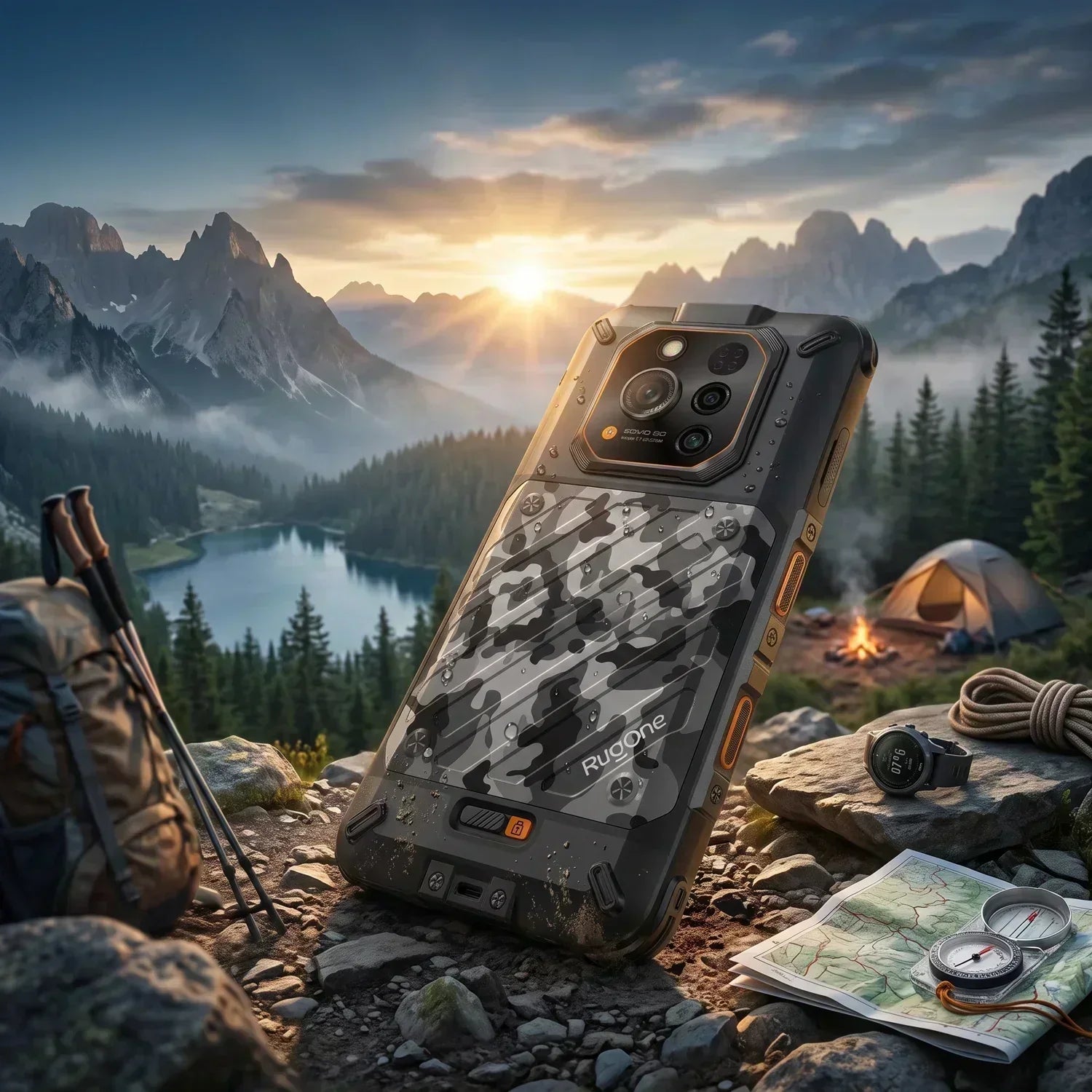
TL;DR: An outdoor phone is a rugged, waterproof smartphone built for hiking, camping, and off-grid adventures. The essentials to look for in 2026 are an IP68/IP69K waterproof rating, MIL-STD-810H drop protection, a swappable battery for multi-day trips, and multi-constellation GPS for accurate navigation off the beaten path. Below, we break down what actually matters, how outdoor phones differ from standard rugged phones, and how RugOne's Xever series stacks up.
Most smartphones aren't built for the outdoors. A sudden rain shower, a drop onto rocky trail, or three days without an outlet can be enough to take a regular phone out of commission — right when you need it most for navigation, communication, or documenting the trip. That's the gap an outdoor phone is designed to fill.
This guide covers what an outdoor phone actually is, the features worth paying attention to, how it compares to a general "rugged phone," and which use cases benefit most from one.
What Is an Outdoor Phone?
An outdoor phone is a smartphone engineered specifically for use in demanding natural environments — trails, campsites, rivers, deserts, and backcountry terrain — rather than for everyday indoor or urban use. It's built around a few core priorities that most consumer phones don't optimize for:
- Surviving water and dust exposure (rain, river crossings, mud, sand)
- Withstanding physical shock (drops onto rock, gear impacts, being tossed in a pack)
- Lasting through multi-day trips without guaranteed access to a charger
- Providing reliable navigation in areas with weak cellular signal or dense tree cover
In short: an outdoor phone trades a bit of slimness and polish for durability and self-sufficiency in places where a broken or dead phone isn't just inconvenient — it can be a real safety issue.
Outdoor Phone vs. Rugged Phone vs. Regular Smartphone
These terms get used interchangeably, but there's a useful distinction:
| Regular Smartphone | Rugged Phone | Outdoor Phone | |
|---|---|---|---|
| Primary design goal | Everyday convenience, thin design | Industrial-grade durability (drops, dust, extreme conditions) | Real-world outdoor use (hiking, camping, navigation) |
| Water resistance | Often limited or splash-only | Usually IP68 or higher | IP68/IP69K expected |
| Battery | Fixed, non-removable | Often larger fixed battery | Frequently swappable for multi-day trips |
| Navigation | Standard GPS | Standard GPS | Multi-constellation (GPS/GLONASS/Beidou/Galileo) common |
| Typical buyer | General consumer | Construction, field service, industrial workers | Hikers, campers, hunters, anglers, overlanders |
In practice, most outdoor phones are rugged phones — the durability testing (drop resistance, waterproofing, dust sealing) is the same underlying engineering. The difference is mainly in framing and feature emphasis: an outdoor phone is marketed and equipped around recreational and off-grid use cases, while a general rugged phone is often positioned toward industrial and jobsite use.
Key Features to Look for in an Outdoor Phone
1. Waterproof and Dust Protection (IP Rating)
Look for an IP68 rating at minimum — this means the device can survive extended submersion in water under controlled conditions. If you're regularly around industrial-strength water exposure (pressure washing, marine spray), IP69K adds resistance to high-pressure, high-temperature water jets. Dust protection matters just as much for desert hikes, dry trail conditions, or sandy coastal environments.
2. Swappable Battery
Charging infrastructure doesn't exist on a three-day backpacking trip. A swappable (hot-swap) battery system solves the problem that "just bring a power bank" doesn't fully address — instead of waiting hours to recharge, you carry a spare battery and swap it in seconds without needing to power down or wait. This is one of the most practical features for genuinely off-grid use, and it's becoming a defining feature of the outdoor phone category rather than a niche add-on.
3. Multi-Constellation GPS Navigation
Standard GPS can lose accuracy in dense forest canopy, canyons, or mountainous terrain. Outdoor phones increasingly support multi-constellation navigation — combining GPS, GLONASS, Beidou, Galileo, and QZSS — which gives the device more satellites to reference for a stronger, more accurate position fix when it matters most.
4. Military-Grade Drop and Shock Resistance
MIL-STD-810H is the U.S. military testing standard most rugged and outdoor phone manufacturers reference. It covers drop resistance, vibration, humidity, temperature extremes, and altitude — giving you a benchmark that's more rigorous and standardized than a manufacturer's own marketing claims.
5. Audio That Cuts Through Outdoor Noise
Wind, rushing water, and open-air environments swallow standard phone speaker volume fast. A genuinely loud, clear speaker (some outdoor phones now push past 100dB) makes a real difference for navigation prompts, calls, or music at a campsite — not just a "nice to have" spec.
6. Low-Light and Night Vision Capability
For early starts, late finishes, or nighttime wildlife observation, an infrared night vision camera extends what you can capture beyond what a standard camera sensor handles in the dark.
Best Use Cases for an Outdoor Phone
Hiking and backpacking: Multi-day trail use is where swappable batteries and multi-constellation GPS matter most — no outlets, unreliable single-satellite signal in valleys and forest cover, and a real cost to a dead phone when it's also your map and emergency contact.
Camping: Extended time away from power sources, plus exposure to rain, condensation, and rough handling around a campsite, makes waterproofing and battery swappability the priority pairing.
Fishing and boating: Water exposure is constant and often unpredictable (splashes, sudden rain, dropped-in-the-water moments), making an IP68/IP69K rating close to non-negotiable.
Hunting: Extended time outdoors, exposure to weather, and situations where a loud speaker or an infrared camera can be genuinely useful — not just marketing add-ons.
Off-grid travel and overlanding: Extended trips without predictable charging access are exactly the scenario swappable batteries were built for.
RugOne Outdoor Rugged Phones: Xever Series Comparison
| Xever 7 | Xever 7 Pro | Xever 8 | |
|---|---|---|---|
| Battery | Dual 5550mAh swappable batteries | Dual 5550mAh swappable batteries | 4800mAh Swappable Battery 2.0 |
| Connectivity | 5G | 5G | 4G |
| Chipset | Dimensity 7025, 24GB+512GB | Dimensity 7025, 24GB+512GB | Helio G200, 8GB RAM, up to 256GB |
| Display | 6.67" 120Hz FHD+ | 6.67" 120Hz FHD+ | 6.50" 120Hz FHD+ |
| Camera | 64MP+50MP+50MP, 64MP night vision | 64MP+50MP+50MP + Thermal Imaging | 64MP + 20MP Infrared Night Vision |
| Audio | Standard | Standard | SonicX Super Speaker (Hi-Fi Audio) |
| Water resistance | IP68 | IP68 | IP68 |
| Standout feature | X-axis linear motor, eSIM | Thermal imaging camera | 320g ultra-light frame, Gorilla Glass 3, Google Gemini built-in |
| Best for | All-around outdoor use, hiking, travel | Hunting, night navigation, thermal detection | Job sites, loud environments, low-light capture |
Which Xever should you pick?
- Choose the Xever 7 if you want a well-rounded outdoor phone with a large, sharp display and dual swappable batteries for extended trips.
- Choose the Xever 7 Pro if thermal imaging matters for your use case — hunting, wildlife tracking, or nighttime navigation where seeing heat signatures gives you a real edge.
- Choose the Xever 8 if loud, clear audio and low-light photography are priorities — it's built around the SonicX speaker and infrared night vision camera, alongside a notably light 320g frame.
How to Choose the Right Outdoor Phone for You
- Start with your trip length. Day trips can usually get by on a large fixed battery. Multi-day trips without charging access should prioritize swappable batteries.
- Match your terrain to your navigation needs. Open terrain is fine with standard GPS. Dense forest, canyons, or mountains benefit from multi-constellation navigation.
- Factor in water exposure realistically. Occasional rain is IP68 territory. Regular water immersion (kayaking, fishing) pushes you toward IP69K.
- Consider what you're actually documenting. Night wildlife or heat-signature tracking benefits from thermal or infrared cameras — most trips don't need this, but for hunting or wildlife observation it's a genuine differentiator, not a gimmick.
-
Don't skip the certification check. MIL-STD-810H and IP68/IP69K aren't marketing buzzwords — they're standardized tests. Look for the actual certification, not just the word "rugged" in the product name.
FAQ
Q: What is an outdoor phone?
A: An outdoor phone is a smartphone built to perform reliably in harsh, unpredictable environments — hiking trails, campsites, deserts, and marine conditions. It typically combines waterproofing, shock resistance, extended battery life, and navigation features that standard consumer phones lack.
Q: Is an outdoor phone the same as a rugged phone?
A: They overlap significantly. 'Rugged phone' usually emphasizes industrial-grade durability testing (drop resistance, dust protection), while 'outdoor phone' emphasizes real-world use cases like hiking, camping, and navigation. Most outdoor phones are also rugged phones, but not every rugged phone is marketed for outdoor recreation.
Q: Do outdoor phones need to be waterproof?
A: Yes. Water exposure from rain, river crossings, or humidity is one of the most common reasons phones fail outdoors. Look for an IP68 rating at minimum, which means the device can withstand extended submersion, and IP69K if you also need resistance to high-pressure water jets.
Q: What's the best battery setup for an outdoor phone?
A: For multi-day trips without reliable charging access, a swappable battery system is the most practical solution. Instead of waiting hours to recharge, you can carry a spare battery and swap it in seconds — a feature increasingly common in outdoor-focused rugged phones.
Q: Do I need GPS on an outdoor phone?
A: If you're hiking or traveling off-grid, yes. Look for multi-constellation navigation support (GPS, GLONASS, Beidou, Galileo, QZSS) rather than GPS alone — it improves positioning accuracy in remote areas like dense forests or canyons where signal from a single satellite system can be unreliable.
Q: Can outdoor phones survive extreme temperatures and drops?
A: Look for MIL-STD-810H certification, a U.S. military testing standard covering drop resistance, temperature extremes, humidity, vibration, and altitude. It's the most widely recognized benchmark for real-world outdoor durability.
Final Thoughts
An outdoor phone isn't just a rugged phone with a nicer name — done right, it's built around the specific failure points that actually happen on trail: dead batteries with no outlet in sight, lost signal in a valley, a phone that can't handle a sudden downpour. If you're choosing your next phone for hiking, camping, or any extended time off-grid, prioritize swappable battery support, multi-constellation GPS, and genuine IP68/MIL-STD-810H certification over marketing language alone.
Explore RugOne's outdoor rugged phone lineup: Xever 7 | Xever 7 Pro | Xever 8