

TL;DR: Missed calls on a job site aren't a signal problem — they're a speaker problem. When ambient noise exceeds your phone's output, it goes silent. The fix is a rugged phone with a verified high-SPL speaker rating.
You're coordinating a crew on a busy construction site. Your phone rings. You feel the vibration, pull it out, and by the time you get it to your ear—missed call.
This happens dozens of times a day to workers in construction, manufacturing, warehousing, and emergency response. It's not a network problem. It's not a reception problem. It's a speaker problem—and most people don't realize it until they've already missed something important.
This guide explains why standard smartphones consistently fail in loud work environments, what actually causes the problem, and what to look for when choosing a phone that works where you work.
The Real Problem: Your Phone's Speaker Wasn't Built for Your Job
Most smartphones are designed for everyday consumer use—office calls, music, video. In those environments, a speaker output of 80–88dB is perfectly adequate.
The problem starts when you take that phone onto a job site, factory floor, or warehouse.
Ambient noise in those environments doesn't stay at comfortable levels. It sits at 90–110dB, sometimes higher during peak operations. When the background noise around you is louder than your phone's maximum speaker output, the phone becomes functionally silent—even at full volume.
This isn't a software bug or a settings issue. It's a fundamental mismatch between consumer audio hardware and industrial noise conditions.
Why This Happens: Understanding the Decibel Gap
Decibels (dB) measure sound pressure level on a logarithmic scale. Every 10dB increase roughly doubles perceived loudness. This means the gap between environments isn't linear—it compounds quickly.
Here's what typical noise levels look like in common work environments:
| Environment | Typical Ambient Noise |
|---|---|
| Office or retail space | 60–70dB |
| Busy warehouse | 75–90dB |
| Construction site | 85–105dB |
| Factory floor (heavy machinery) | 90–110dB |
| Emergency scene (sirens, generators) | 95–120dB |
A standard smartphone rated at 85dB trying to produce audible audio in a 100dB environment isn't just quiet—it's completely masked. The ambient noise physically overpowers the speaker output before the sound reaches your ears.
This is why vibration-only awareness of incoming calls becomes the default for so many field workers. The phone rings, but no one can hear it ring.
The Consequences of Inaudible Communication on the Job
Missing a call at home is a minor inconvenience. Missing communication on a job site or factory floor has real operational and safety implications.
Missed coordination calls between foremen and crews cause delays, repeated work, and wasted materials. A crew waiting for direction because a call didn't get through is a direct cost.
Inaudible safety alerts are a more serious issue. Emergency notifications, evacuation tones, and critical alarm push notifications are only useful if the worker actually receives them. A 80dB notification tone on a 100dB factory floor will never be heard.
Over-reliance on text as a fallback creates its own problems—workers operating equipment, wearing gloves, or moving through hazardous areas cannot safely stop to read and respond to messages every few minutes.
Repeated call attempts waste time and create frustration across teams. When workers know their phones won't be heard, they stop relying on them—and the communication breakdown becomes structural.
What "Loud Enough" Actually Means for Field Work
The threshold where a smartphone becomes reliably useful in industrial environments starts at roughly 110dB of speaker output. At that level, the phone has meaningful headroom above most standard construction and factory noise.
Devices specifically engineered for high-noise environments push further—to 117dB. At that output level, a phone placed on a work surface, clipped to a belt, or sitting in a chest pocket can be heard during most normal industrial operations without requiring the user to hold it to their ear.
This is a measurable, hardware-level specification—not a marketing category. When evaluating phones for field deployment, the speaker SPL (sound pressure level) rating should be treated the same way as IP rating or MIL-STD certification: as a concrete, verifiable number that either meets your environment's requirements or doesn't.
What to Look for When Choosing a Phone for Noisy Environments
Not all "rugged" phones are loud phones. Rugged certification (IP68, MIL-STD-810) addresses physical and environmental durability—it says nothing about speaker output. A phone can be fully waterproof and still be completely inaudible on a construction site.
When selecting a smartphone for high-noise field deployment, evaluate these factors:
Speaker Output Rating (SPL)
Look for a manufacturer-published dB rating at maximum output. Consumer smartphones rarely publish this figure prominently because it's not a differentiator for their market. Purpose-built field devices should list it as a primary specification. For genuinely noisy environments, prioritize devices rated at 110dB or above.
Driver Size
Larger speaker drivers move more air and generally produce louder, cleaner sound. Consumer smartphones typically use drivers in the 9×15mm to 11×18mm range. Devices designed for high-volume output use significantly larger drivers—13×26mm or equivalent—which directly affects maximum SPL and tonal quality at high volumes.
Audio Processing Software
Raw hardware volume alone doesn't guarantee intelligibility. Look for devices with dedicated audio processing that boosts vocal frequency ranges (300Hz–4kHz) and applies noise-floor compensation. Some manufacturers have developed proprietary algorithms—such as the SonicX system in the RugOne Xever 8—that combine hardware output with AI-assisted vocal enhancement to improve clarity at high volumes, not just loudness.
Speaker Placement
Front-facing or side-facing speakers perform significantly better in open-air field conditions than rear-facing speakers. When a phone is placed on a surface or clipped to clothing, a rear-facing speaker loses substantial output to absorption. Speaker orientation is a practical consideration that's often overlooked in spec comparisons.
Push-to-Talk (PTT) Compatibility
For teams that need real-time voice coordination, PTT app compatibility combined with a high-output speaker can reduce or eliminate the need for separate two-way radio hardware. This is a consolidation benefit worth factoring into total cost of deployment.
Use Cases: When a High-Decibel Rugged Phone Solves a Real Problem
Construction Site Coordination
A foreman managing multiple crews across a noisy site needs reliable incoming call awareness without stopping to check the phone every few minutes. A 117dB-rated device worn on a belt clip will ring audibly above typical construction site noise, allowing the foreman to catch calls hands-free without disrupting workflow.
Factory Floor Safety Management
Safety supervisors responsible for emergency notification delivery cannot rely on standard smartphone alert tones that are inaudible against 95–100dB machinery noise. A high-decibel device configured to push safety alerts at maximum volume closes this gap without requiring additional hardware.
Warehouse and Logistics Routing
Warehouse workers coordinating inbound and outbound shipments via voice need to receive routing instructions and confirmation calls while operating in forklift traffic, near conveyor systems, and around loading dock equipment. Speakerphone at 117dB output is audible in these conditions; speakerphone at 85dB is not.
Emergency Response Operations
Firefighters, paramedics, and search-and-rescue personnel operate in environments where noise levels are both extreme and unpredictable. A loud rugged smartphone functioning as a supplementary communication device—for GPS navigation audio, incoming dispatch calls, or PTT coordination—needs to be audible over scene noise without requiring the responder to remove hearing protection or stop what they're doing.
Outdoor Field Teams
Utility crews, survey teams, and agricultural operations workers face different noise profiles—wind, heavy machinery, open-air acoustic dispersion—but the core problem is the same. Standard phone speakers lose effective range quickly in open-air conditions. High-output speakers maintain intelligibility at greater distances and in more variable acoustic environments.
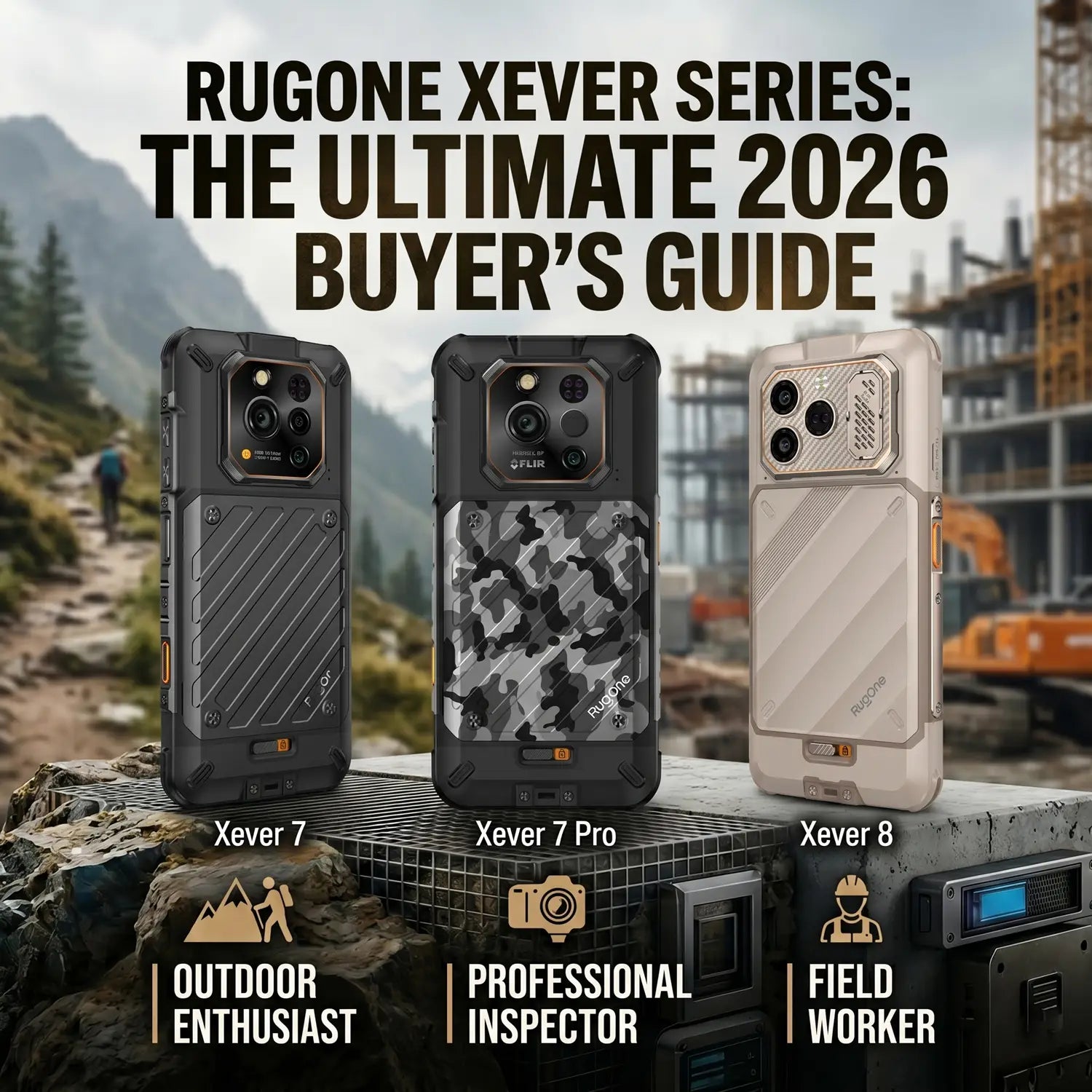
How the RugOne Xever 8 Addresses This Problem
The Xever 8 is a rugged smartphone built around a 13×26mm speaker driver housed in an engineered acoustic chamber, producing a rated output of 117dB. This positions it above most industrial ambient noise levels without requiring the user to hold the device to their ear.
The SonicX audio system applies software-layer processing on top of the hardware output—real-time frequency equalization, vocal range boosting, and AI Vocal Enhancement that targets speech intelligibility specifically. The result is audio that is designed to be both louder and clearer than raw driver output would produce.
On the durability side, the Xever 8 carries IP68/IP69K and MIL-STD-810H certification, covering submersion, dust ingress, drops, temperature extremes, and vibration. This means the same device that handles the acoustic demands of a noisy job site also handles the physical demands of field deployment.
For teams evaluating a single device that covers communication reliability, physical durability, and field usability without separate PTT hardware, the Xever 8 is a practical reference point—not because it's the only option, but because it combines these specifications in a verifiable, deployable package.
Pros and Cons of High-Decibel Rugged Smartphones
Pros
- Audible in real industrial conditions: 110–117dB output creates genuine headroom above 90–100dB ambient environments
- Reduces missed calls and alerts: The primary failure mode—inaudible communication—is directly addressed at the hardware level
- Hands-free usable: Belt-clip or surface-placed speakerphone operation is practical at high output levels
- Consolidates hardware: Can replace or supplement dedicated PTT devices for teams with cellular or Wi-Fi coverage
- Measurable specification: SPL rating is a verifiable number, not a subjective claim—easier to evaluate and compare than vague "rugged" marketing
Cons
- Higher unit cost: Purpose-built high-output speaker hardware adds to device price versus standard rugged phones
- Battery consumption: Sustained high-volume use draws significantly more power; battery life at maximum volume will be shorter than rated figures
- Not a universal replacement for two-way radio: In no-signal zones or regulated industries, dedicated radio hardware retains its advantages
- Hearing safety at close range: 117dB held directly to the ear exceeds safe exposure thresholds—these devices are designed for speakerphone use, not ear-contact use at maximum volume
- Open-air acoustic losses: Even at 117dB, extreme wind or highly reverberant environments will reduce effective intelligibility
FAQ
Q: My current rugged phone is IP68 rated but I still can't hear calls on site. Why?
A: IP68 certification covers water and dust resistance—it has no relation to speaker output. Many rugged phones are physically durable but use the same 80–88dB speaker hardware as standard consumer devices. If your environment exceeds 90dB ambient noise, an IP68 rating alone won't solve the communication problem. You need a device with a high SPL speaker rating in addition to physical durability certification.
Q: How loud is 117dB compared to everyday reference points?
A: 90dB is roughly equivalent to a running lawn mower. 100dB approximates a jackhammer at 15 meters. 110dB is close to a chainsaw at arm's length. 117dB approaches the output of a live music concert front-of-house speaker. Crucially, because the decibel scale is logarithmic, a 117dB phone is not just slightly louder than an 88dB phone—it is perceived as approximately 4–5 times louder.
Q: Can I just use a Bluetooth speaker with my current rugged phone instead?
A: A Bluetooth speaker can increase audio output, but introduces practical trade-offs: it's a separate device to charge, carry, pair, and protect. In dynamic field environments where workers are moving between locations, operating equipment, or working in rain and mud, a separate speaker creates points of failure. A phone with integrated high-output speaker removes those dependencies entirely.
Q: What's the difference between a loud phone and a phone with good call clarity in noise?
A: Loudness (SPL) and clarity are related but distinct. A phone can be very loud but produce distorted or unclear audio at maximum volume, making voices difficult to understand even when they're audible. Good call clarity in noise requires both sufficient SPL output and audio processing that prioritizes speech frequencies and minimizes distortion at high volumes. When evaluating devices, look for both the dB rating and whether the manufacturer specifies any vocal enhancement or noise compensation processing.
Q: Is a high-decibel smartphone suitable for workers who already wear hearing protection?
A: Yes—this is actually one of the primary use cases. Workers wearing earmuffs or earplugs cannot hold a standard phone to their ear effectively. A high-decibel smartphone used in speakerphone mode at a distance (on a belt, on a surface, or in a chest pocket) can be heard through moderate hearing protection. For workers in environments requiring hearing protection, speakerphone + high SPL output is often the only practical way to use a smartphone for voice communication on the job.
Conclusion
The gap between a standard consumer smartphone and a genuinely field-usable communication device isn't primarily about durability—it's about audio output.
Workers in construction, manufacturing, logistics, and emergency response don't need a phone that survives being dropped. They need a phone they can actually hear when it rings. Those two requirements often come packaged together in the rugged smartphone category, but speaker output is consistently the underspecified variable.
When evaluating smartphones for field deployment, treat SPL rating as a primary specification alongside IP rating and MIL-STD certification. Ask manufacturers for the dB number. Compare it against the ambient noise level of your actual work environment. The math is straightforward—and it will tell you more about whether a device will work on your job site than any marketing category will.