

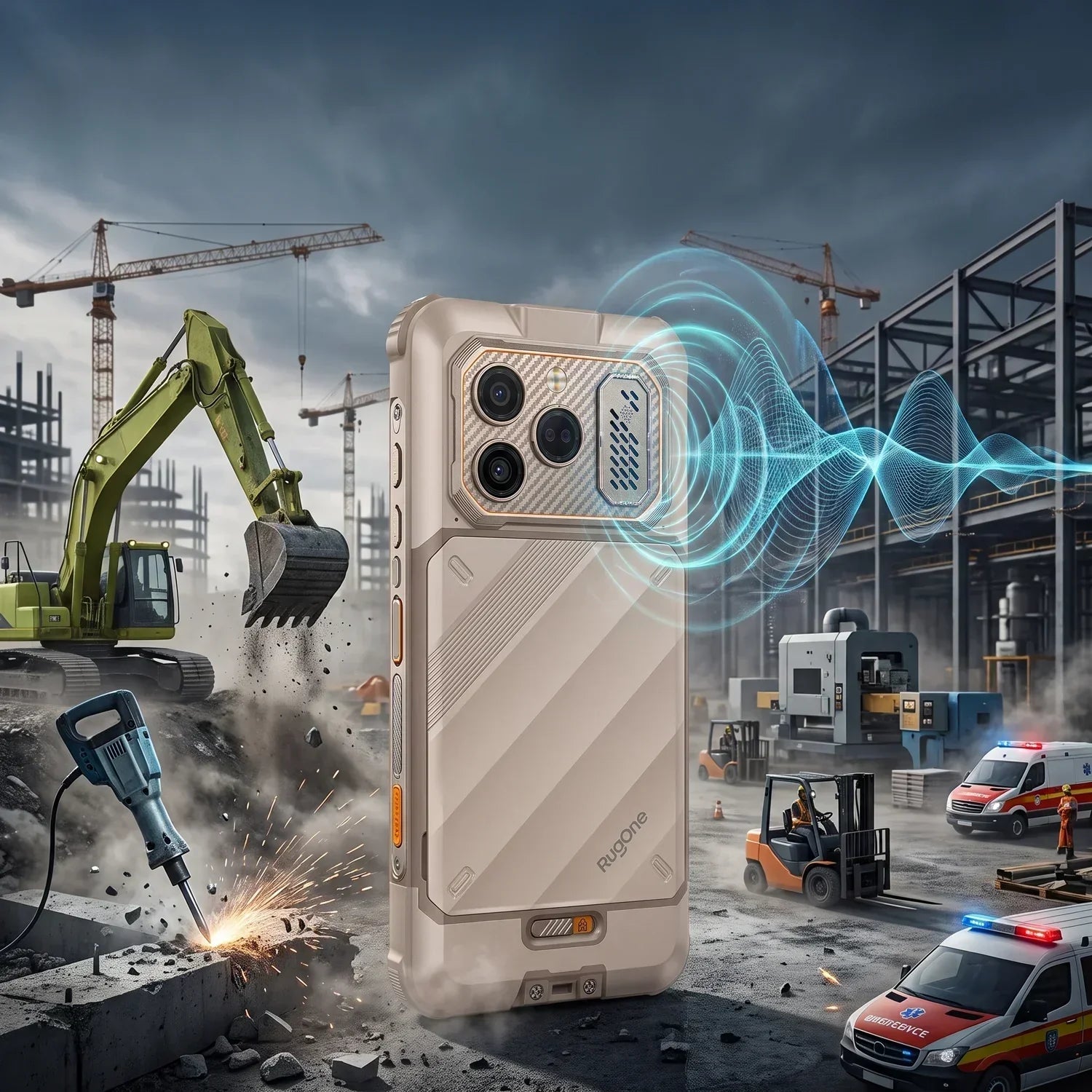
TL;DR: Industrial noise regularly hits 90–110dB. Standard smartphones max out at 80–88dB. A rugged phone rated at 117dB — like the RugOne Xever 8 — closes that gap and keeps field communication audible.
On a construction site running jackhammers, in a factory floor humming with heavy machinery, or at an emergency scene filled with sirens and shouting—smartphones consistently fail at their most basic job: being heard.
Most consumer smartphones top out at 80–90dB. Industrial ambient noise regularly hits 95–110dB or higher. This gap isn't a minor inconvenience—it's a communication failure that can mean a missed safety alert, a delayed emergency response, or a miscommunicated instruction that costs time and money.
This article examines why audio output matters in professional rugged smartphone selection, what 117dB actually means in context, and how modern speaker engineering is designed to close that gap.
What Is a High-Decibel Rugged Smartphone?
A high-decibel rugged smartphone is a mobile device engineered to operate reliably in physically demanding environments and to produce audio output loud enough to be audible over significant ambient noise.
"Rugged" typically refers to mechanical and environmental durability—resistance to drops, dust, water, and temperature extremes, often certified to MIL-STD-810 or IP68/IP69K standards. "High-decibel" refers specifically to speaker output measured in decibels (dB), a logarithmic unit where every 10dB increase roughly doubles perceived loudness.
Most standard smartphones produce 80–88dB at maximum volume under lab conditions. A device rated at 117dB produces audio that is approximately 4–5 times louder in perceived intensity than an 88dB device. This difference is meaningful in environments where ambient noise already sits at or above 90dB.
Why It Matters: The Noise Problem in Industrial Workplaces
Ambient Noise Levels at Work
OSHA defines 85dB as the action level for hearing protection programs and 90dB as the permissible exposure limit for an 8-hour workday. In practice, many industrial environments operate at levels significantly above these thresholds:
- Construction sites: 85–105dB (jackhammers, concrete saws, heavy equipment)
- Factory floors: 90–110dB (stamping presses, conveyor systems, HVAC)
- Emergency scenes: 95–120dB (sirens, generators, crowd noise)
- Warehouses: 75–95dB (forklifts, loading docks, PA systems)
When ambient noise approaches or exceeds a smartphone's speaker output, the device becomes functionally silent for voice calls and audio alerts.
The Communication Gap
The failure isn't theoretical. Workers in high-noise environments routinely report:
- Missed incoming calls despite the phone being in a chest pocket or on a workbelt
- Inaudible alert tones for safety alarms or emergency notifications
- Inability to use speakerphone for hands-free communication during tasks
- Dependence on vibration alone, which fails when equipment creates persistent vibration
This is the core problem a high-decibel rugged smartphone is designed to address.
Key Features That Define Loud Rugged Smartphones
When evaluating rugged phones for high-noise environments, the following hardware and software characteristics determine real-world audio performance:
Speaker Hardware
- Driver size: Larger drivers (e.g., 13×26mm) move more air and generally produce higher volume and lower distortion at high output levels
- Sound cavity design: Internal acoustic chambers amplify and direct sound; larger cavities tend to produce fuller, louder output
- Dual driver configuration: Some devices use multiple drivers for wider frequency response and louder combined output
- Speaker placement: Front-facing or side-facing speakers perform better than rear-facing in loud environments where the phone is not held to the ear
Audio Software
- AI audio enhancement: Algorithms that dynamically boost vocal frequencies and suppress background noise improve intelligibility even when raw volume is high
- Frequency response tuning: Prioritizing mid-range frequencies (where human speech sits, roughly 300Hz–3kHz) improves clarity in noise
- Volume normalization: Consistent output at maximum levels without clipping or distortion
Loudness Rating
- Measured in dB (decibels) under standardized conditions
- Ratings above 110dB begin to meaningfully exceed standard industrial ambient noise levels
- 117dB represents a ceiling for current consumer-grade rugged smartphones as of 2025–2026
Use Cases: Where High-Decibel Audio Makes a Practical Difference
1. Construction Site Foremen and Site Supervisors
A site foreman coordinating multiple crews across a noisy job site cannot stop work to walk between teams. Voice calls and speakerphone communication are the primary coordination tools. A phone that cannot be heard over a concrete mixer or a running generator effectively removes voice communication as an option.
A 117dB-rated device allows hands-free speakerphone communication from a work belt or hard hat clip without the call being drowned out by ambient construction noise.
2. Factory Floor Safety Supervisors
Safety alerts on the factory floor—shift change notifications, equipment fault warnings, evacuation alarms—are only useful if workers can hear them. A standard smartphone notification tone at 80dB will be inaudible against a 95dB factory floor background.
High-decibel smartphones can serve as secondary alert devices, pushing critical safety notifications at volumes that penetrate ambient noise without requiring the worker to be actively checking the screen.
3. Emergency Response Personnel
Firefighters, paramedics, and search-and-rescue (SAR) teams operate in environments where noise levels are unpredictable and often extreme. During active operations, a missed radio call or inaudible GPS direction can affect response outcomes.
A rugged smartphone with 117dB output and push-to-talk capability can function as a supplementary communication tool, audible over scene noise without requiring the user to remove hearing protection.
4. Warehouse and Logistics Workers
High-traffic warehouse environments involve forklift noise, conveyor systems, and PA announcements. Workers managing inventory or coordinating shipments via smartphone often cannot hear incoming calls or routing instructions while on the floor.
High-volume speaker output allows these workers to receive and respond to communication without stepping out of the operational area.
5. Outdoor Field Teams (Utilities, Survey, Agriculture)
Teams working outdoors in remote or semi-remote environments face different noise challenges: wind, heavy equipment, or large distances between team members. A loud, durable smartphone reduces dependence on dedicated walkie-talkie hardware by extending effective voice communication range and intelligibility in open-air conditions.
How It Works: The Engineering Behind 117dB Output
Achieving 117dB from a smartphone-sized device requires deliberate acoustic engineering across multiple components.
Driver Specifications
The RugOne Xever 8 uses a 13×26mm speaker driver—significantly larger than the 9×15mm to 11×18mm drivers common in standard consumer smartphones. A larger driver moves a greater volume of air per oscillation cycle, which directly increases maximum sound pressure level (SPL) output.
Acoustic Chamber Design
The speaker driver sits within an engineered sound cavity that functions as an acoustic resonance chamber. The cavity's volume, shape, and material affect how sound waves are reflected and amplified before leaving the device. On the Xever 8, this chamber is optimized to maximize output at vocal frequency ranges (300Hz–4kHz) without sacrificing structural integrity.
SonicX Algorithm and AI Vocal Enhancement
Raw driver output alone does not guarantee intelligibility. The SonicX algorithm is a software-layer audio processing system that applies:
- Dynamic frequency equalization, boosting speech-range frequencies
- AI-driven noise floor modeling to adjust output based on detected ambient noise
- Clipping prevention at high volume levels to maintain voice clarity without distortion
AI Vocal Enhancement specifically targets the intelligibility of incoming voice calls and media audio by isolating and amplifying vocal frequency bands while reducing non-vocal noise artifacts.
Output Rating: 117dB
The 117dB rating represents the peak sound pressure level measured at a standardized test distance. At this output level, the Xever 8's speaker system is designed to remain audible against ambient noise environments up to approximately 100–105dB, accounting for the acoustic energy losses that occur in open-air industrial settings.
Pros and Cons: High-Decibel Rugged Smartphones in Practice
Pros
- Audible in genuine industrial noise: 110–117dB output creates meaningful headroom above 90–100dB ambient environments
- Reduces missed communications: Calls, alerts, and push-to-talk messages are more likely to be received and acknowledged
- Reduces reliance on dedicated hardware: One device can replace or supplement walkie-talkies in some deployment scenarios
- Hands-free usability: Belt-clip or surface-placed speakerphone operation is viable in louder environments
- Improved safety communication: Emergency alerts and evacuation tones are more likely to reach workers on noisy floors
Cons
- Volume ≠ clarity at all frequencies: High SPL ratings are often measured at specific frequencies; real-world vocal clarity depends on driver quality, equalization, and software processing
- Battery trade-off: Sustained high-volume output draws significantly more power than normal-volume use; battery life under high-volume conditions will be shorter than rated figures suggest
- Hearing safety consideration: 117dB at close range (holding the device to the ear) exceeds safe exposure thresholds for unprotected hearing; high-volume use is intended for speakerphone/open-air use, not for direct ear contact
- Environmental variability: Open-air industrial environments with high wind or significant reverberation may reduce effective intelligibility even at high SPL
- Premium cost: Devices with engineered high-output speaker systems typically sit in the upper price tier of the rugged smartphone market
FAQ
Q: What does 117dB mean for a smartphone speaker?
A: 117dB is a measurement of sound pressure level (SPL)—how loud the speaker is at a standardized test distance. For reference, 90dB is roughly equivalent to the noise of a running lawn mower, and 110dB approximates a live concert. A 117dB rating means the device's speaker output exceeds most standard industrial ambient noise levels, making it audible in environments where a typical 80–88dB smartphone would be inaudible.
Q: Will a 117dB rugged smartphone actually be heard on a construction site or factory floor?
A: It depends on the specific ambient noise level and acoustic conditions. A device rated at 117dB has approximately 15–25dB of headroom above typical construction site noise (90–100dB). In most standard industrial environments, a 117dB device will be audible from a workbelt or nearby surface. However, in extreme-noise environments (>110dB continuous ambient noise), proximity and speaker orientation still matter. Speakerphone placed face-up or clipped to clothing at chest level performs better than a device in a pocket.
Q: Is a loud rugged smartphone a replacement for a walkie-talkie?
A: In some scenarios, yes—but not universally. Modern rugged smartphones with push-to-talk (PTT) apps and loud speaker output can replicate walkie-talkie functionality for teams with reliable cellular or Wi-Fi coverage. However, dedicated two-way radios have advantages in license-free frequency access, coverage in no-signal zones, and regulatory compliance in specific industries (e.g., aviation, emergency services). For most construction, logistics, and field service teams, a high-decibel rugged smartphone is a practical alternative or supplement to dedicated PTT hardware.
Q: What is the SonicX algorithm and how does it differ from standard smartphone audio?
A: SonicX is an audio processing algorithm developed for the RugOne Xever 8 that combines hardware-level speaker output with software-layer equalization and AI-assisted vocal enhancement. Standard smartphones typically apply basic dynamic range compression to protect speakers from distortion. SonicX additionally performs real-time frequency analysis, boosts vocal clarity bands, and applies AI Vocal Enhancement to improve speech intelligibility at high volume levels—not just loudness. The result is that voice calls and audio alerts are designed to be both louder and clearer than raw hardware output would produce.
Q: Does high speaker volume damage the smartphone over time?
A: Sustained high-volume use at maximum SPL can stress speaker components over time, particularly drivers not engineered for sustained high output. Devices purpose-built for high-decibel performance (like the Xever 8 with its 13×26mm driver) are designed to handle extended high-volume operation without component failure under normal use conditions. That said, regular sustained use at maximum volume in very hot or very dusty environments may shorten speaker lifespan versus average use. Checking manufacturer warranty terms related to speaker components is advisable for heavy-duty deployments.
Q: Are there OSHA or safety implications for using a very loud smartphone on a job site?
A: OSHA noise standards regulate worker exposure to workplace noise—they do not restrict the output level of personal communication devices. However, holding a 117dB-rated device directly to the ear would expose the ear canal to potentially harmful sound pressure levels. High-decibel rugged smartphones are designed for speakerphone use at a distance, or for use in environments where the ambient noise level means the device's volume is necessary to be heard at all. Workers using these devices should continue to wear OSHA-mandated hearing protection appropriate for their environment and use the smartphone in speakerphone or PTT mode rather than holding it to the ear at maximum volume.
Conclusion
Smartphone audio output is rarely treated as a critical specification—but for workers operating in high-noise industrial environments, it determines whether a device is actually useful on the job.
The gap between a standard consumer smartphone (80–88dB) and a purpose-built high-decibel rugged device (117dB) is not incremental. It represents the difference between a missed call and a received one, between an inaudible alert and an actionable warning.
The engineering behind high-decibel output—larger drivers, tuned acoustic chambers, software-layer processing, and AI vocal enhancement—reflects a deliberate design choice to prioritize real-world utility in the environments where rugged smartphones are actually deployed.
For procurement teams evaluating rugged smartphones for field, factory, or emergency response use, speaker loudness rating and vocal clarity in noise should sit alongside durability certification, battery life, and connectivity specifications as primary evaluation criteria.
This article references specifications associated with the RugOne Xever 8 and the SonicX audio system. Decibel ratings are based on manufacturer-published specifications measured under standardized test conditions. Real-world performance will vary by environment.