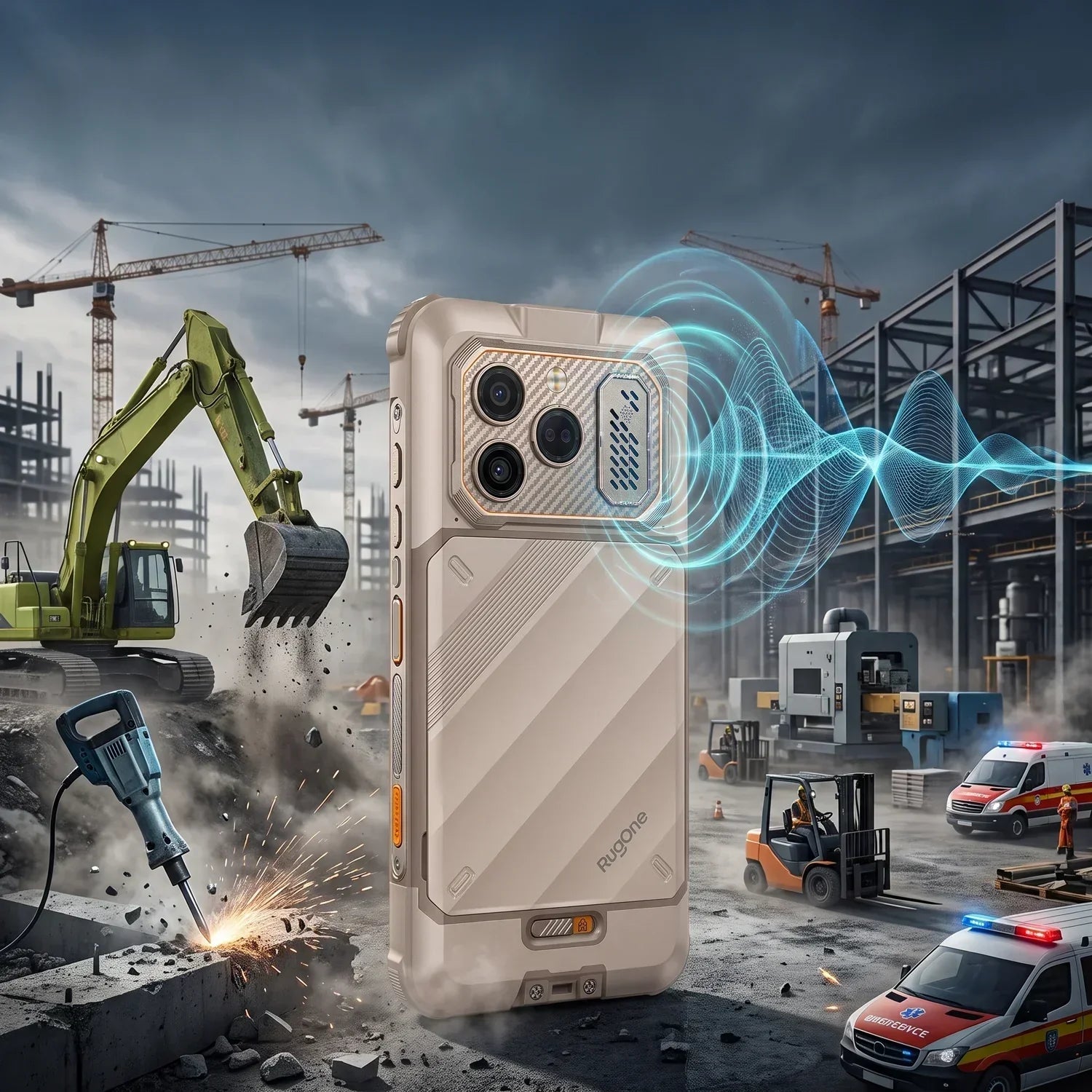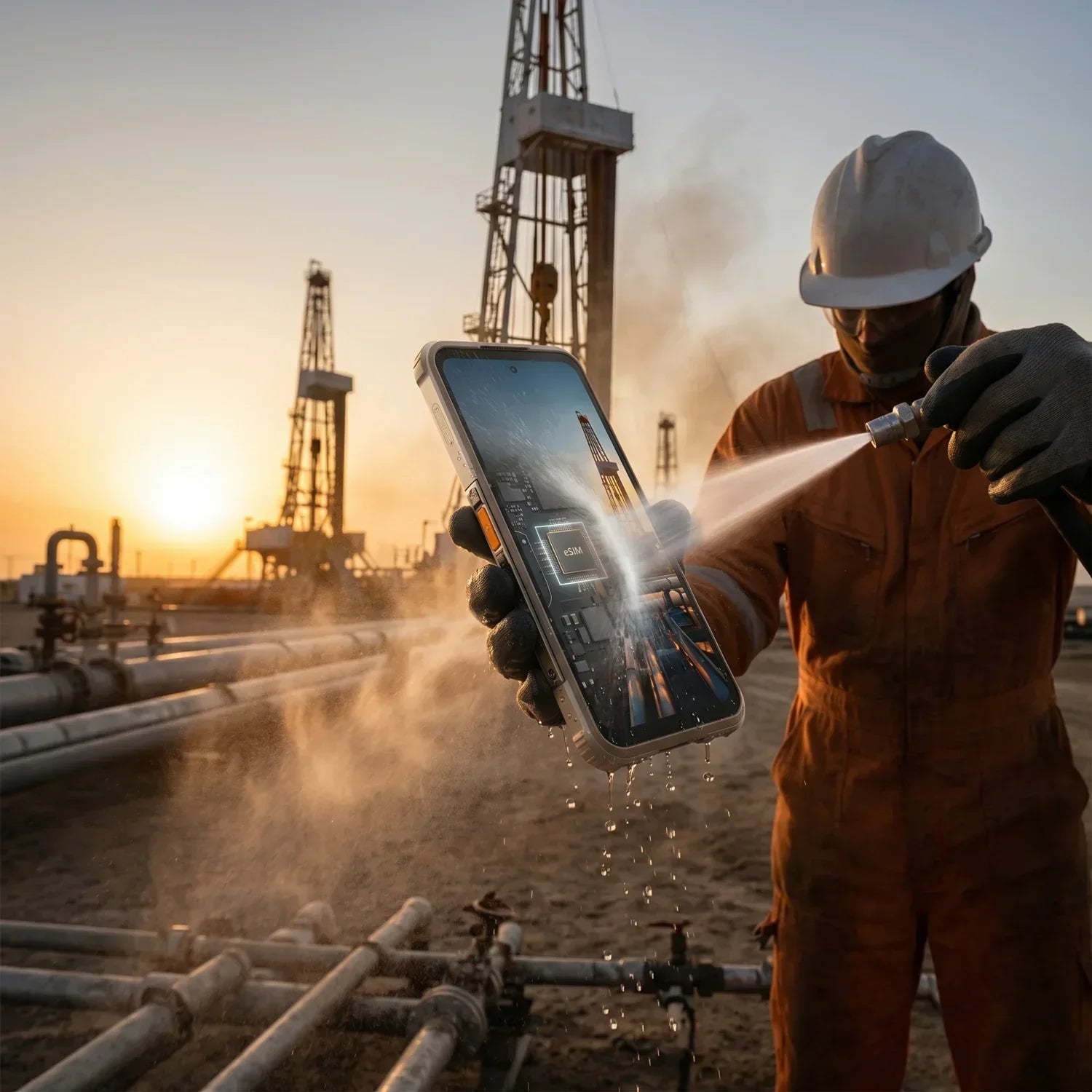


Field workers operate in environments where standard consumer devices struggle to survive — dust, rain, vibration, and temperature extremes are daily conditions. But beyond physical durability, another challenge is often overlooked: the need for fast, reliable, hands-free data interaction in the field.
Near Field Communication (NFC) has quietly become one of the most practical connectivity features for field service operations. Whether it's scanning an equipment tag, clocking in at a remote site, or unlocking a secure access point, NFC allows workers to complete tasks with a single tap — no manual entry, no connectivity delays, no fumbling with credentials.
This article explains what NFC does on a rugged phone, why it matters for field-based roles, and how it's being applied across real-world industries today. Devices like the RugOne Xever series — purpose-built rugged smartphones with NFC built in — represent the type of hardware increasingly being deployed in these workflows.
What Is NFC on a Rugged Phone?
Near Field Communication (NFC) is a short-range wireless technology that enables data exchange between two devices — or between a device and a passive tag — when they are placed within approximately 4 centimeters (1.5 inches) of each other.
On a rugged smartphone, NFC functions the same way it does on a consumer device, but within a hardware platform engineered for harsh environments. The phone's NFC antenna is embedded behind the rear casing, and the technology operates at 13.56 MHz — a standardized frequency used globally across access cards, asset tags, payment terminals, and industrial sensors.
Rugged phones with NFC typically support the following NFC modes:
- Reader/Writer mode — reads NFC tags (e.g., equipment labels, inspection points)
- Card Emulation mode — the phone acts as a contactless card (e.g., for access control)
- Peer-to-Peer mode — exchanges data between two NFC-enabled devices
These three modes cover most enterprise use cases, from asset management to identity verification.
Why NFC Matters for Field Workers
In office environments, most digital workflows rely on stable Wi-Fi, USB peripherals, and stationary workstations. Field workers don't have that luxury. Their workflows need to function while wearing gloves, standing on a ladder, working in a noisy warehouse, or responding to an emergency.
NFC addresses this by reducing complex interactions to a single physical tap. The key advantages for field environments include:
- No manual data entry required — reduces errors caused by typing on small screens in difficult conditions
- Works offline — NFC tag reads don't require an internet connection at the moment of scan
- Fast authentication — contactless ID verification takes under a second
- Low power consumption — NFC draws minimal battery, important for long shifts without charging access
- Passive tags need no power source — NFC tags embedded in equipment or facilities require no battery, making them low-maintenance over years of use
For workers whose time and accuracy directly affect operational outcomes, these properties are meaningful — not marginal.
Key Features to Look for in a Rugged Phone with NFC
Not all NFC implementations are equal. When evaluating a rugged phone for NFC-based field workflows, the following specifications matter:
- NFC with Google Pay and transit card support — indicates the device supports both payment-grade card emulation and transit/loyalty credential storage, covering the most common enterprise contactless use cases
- Android HCE (Host Card Emulation) support — required for software-based card emulation without a physical SIM-based secure element
- IP68 or IP69K rating — ensures the device can be used during rain, near water, or in high-pressure wash-down environments without risking NFC antenna damage. The RugOne Xever 7, Xever 7 Pro, and Xever 8 all carry both IP68 and IP69K certification
- MIL-STD-810H certification — confirms the phone has passed standardized drop, shock, and temperature tests; all three RugOne Xever models meet this standard
- Tag read range — most enterprise NFC tags are readable at 0–4 cm; antenna placement on the device affects real-world usability
- Dual shortcut keys — physical programmable keys (present on RugOne Xever devices) allow workers to launch NFC-dependent apps instantly without navigating a touchscreen
Use Cases: How Field Workers Are Using NFC Today
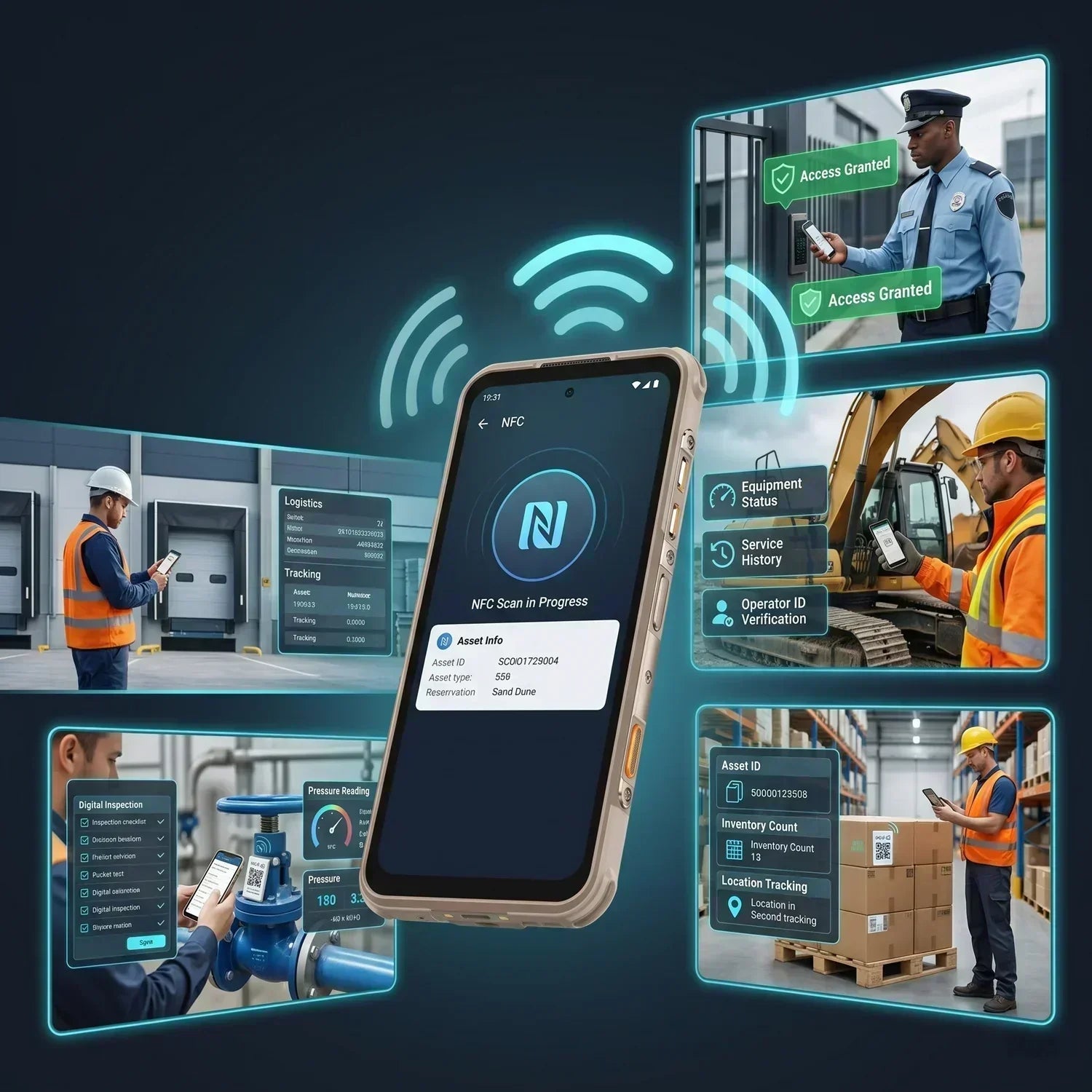
1. NFC Access Control
Security personnel and workers who need to enter secured areas — server rooms, utility substations, restricted construction zones — often rely on RFID/NFC access cards. A rugged phone with card emulation mode can replace the physical card entirely.
The worker's credentials are stored in the phone via an HCE application. Presenting the phone to an NFC reader at an access point authenticates entry. This reduces the risk of lost access cards and centralizes credential management through mobile device management (MDM) platforms. On devices like the RugOne Xever series, Google Pay and transit card support confirms that the card emulation layer is active and functional out of the box.
2. NFC Asset Tracking and Equipment Management
In logistics warehouses, construction sites, and manufacturing plants, tracking physical assets manually is time-consuming and error-prone. NFC tags attached to tools, machinery, or containers allow workers to log asset location, condition, and usage with a single tap.
Field workers scan the tag, and the associated app records the timestamp, worker ID, and GPS location — all without typing. This creates a time-stamped audit trail that integrates directly into enterprise asset management systems. The multi-navigation support (GPS, GLONASS, Beidou, Galileo) found in the RugOne Xever lineup ensures location data is reliable even in remote or partially obstructed environments.
3. NFC Equipment Inspection and Maintenance Logging
Maintenance technicians performing scheduled inspections often follow multi-point checklists across dozens of equipment units. NFC tags mounted on each piece of equipment serve as physical checkpoints.
By tapping the tag at each inspection point, the technician confirms physical presence at that location — something GPS alone cannot verify with sufficient accuracy. The inspection record is automatically associated with that specific asset, reducing paperwork and creating reliable maintenance histories. This is particularly valuable in industries with compliance requirements, such as utilities, oil and gas, and building management.
4. NFC Attendance and Workforce Verification
Remote sites — pipeline stations, cell towers, offshore facilities — often lack reliable internet or barcode scanner infrastructure. NFC-based attendance systems use fixed NFC readers or tags at site entry points.
Workers tap their phone to check in and out, and the data syncs to the central HR or workforce management system once connectivity is available. This approach is more tamper-resistant than GPS check-ins and more practical than manual timesheets. For deployments on rugged phones with swappable batteries — such as the RugOne Xever 7 series with its 5550mAh hot-swap battery — continuous device availability across long shifts is not a limiting factor.
5. NFC for Contactless Authentication in Field Applications
Field service technicians accessing enterprise applications — work order systems, customer databases, configuration tools — increasingly require two-factor or multi-factor authentication. NFC-based hardware tokens or smart cards can serve as a second authentication factor.
The technician taps an NFC token or card to their rugged phone before gaining access to a sensitive system. This satisfies enterprise security policies without requiring separate authentication hardware or complex password entry in the field.
6. NFC for Inventory and Parts Management
Warehouse staff and logistics teams use NFC tags on shelving units, pallets, and individual SKUs to speed up receiving, picking, and dispatch operations. A rugged phone with NFC allows workers to verify stock, log transactions, and update inventory records instantly — replacing handheld barcode scanners in some workflows.
NFC is particularly useful for smaller parts or components where barcode printing is impractical, and where the tag can be embedded inside the item rather than printed on the surface. The eSIM capability in the RugOne Xever series also allows warehouse devices to stay connected across multiple carrier networks without manual SIM management.
How NFC Works on a Rugged Phone
When an NFC-enabled rugged phone is brought within range of an NFC tag or reader, the following sequence occurs:
- Field detection — The phone's NFC controller generates a radio frequency field at 13.56 MHz.
- Tag activation — A passive NFC tag (which has no battery) draws power from this field and activates.
- Data exchange — The tag transmits its stored data (a URL, an ID number, a configuration record, etc.) to the phone within milliseconds.
- App processing — The phone's NFC-enabled application receives and processes the data, triggering the appropriate action (opening a work order, logging a timestamp, authenticating a user, etc.).
For card emulation scenarios, the process reverses: the phone generates its own NFC signal and responds to an external reader's query, presenting stored credentials as if it were a physical smart card.
The entire exchange typically completes in under 500 milliseconds, which is why NFC is suited to high-frequency, high-volume field interactions.
Pros and Cons of NFC on Rugged Phones
Advantages
| Factor | Detail |
|---|---|
| Speed | Tag reads complete in under 1 second |
| Offline capability | Works without active network connection; syncs later |
| Accuracy | Eliminates manual entry errors |
| Low infrastructure cost | Passive NFC tags are inexpensive and maintenance-free |
| Security | NFC's 4 cm range significantly limits unintended reads |
| Workflow integration | Compatible with enterprise MDM, ERP, and CMMS platforms |
| Durability pairing | NFC is most useful when paired with IP68/IP69K-rated hardware that can survive the same environments as the NFC tags |
Limitations
| Factor | Detail |
|---|---|
| Short range | Limited to ~4 cm; requires physical proximity |
| Tag durability | NFC tags in harsh environments require industrial-grade enclosures |
| Device-specific antenna placement | Read performance varies by phone model; antenna location matters |
| Dependent on software ecosystem | NFC utility depends on available enterprise apps and integrations |
| Not a replacement for barcode at distance | NFC cannot scan from several meters away like some RFID systems |
FAQ
Q: Can a rugged phone with NFC replace a physical access card?
A: In many cases, yes. Rugged phones that support Android Host Card Emulation (HCE) can emulate an NFC access card at software level, without requiring a physical card or SIM-based secure element. The RugOne Xever series, for example, supports Google Pay and transit card emulation, which uses the same card emulation layer. However, compatibility depends on the access control system in use — older proprietary protocols may not be supported. IT and security teams should verify compatibility with existing reader infrastructure before deploying at scale.
Q: Does NFC work without an internet connection?
A: The NFC read or write action itself does not require internet connectivity. The phone can scan a tag and store the result locally. However, syncing that data to a backend system — such as an asset management platform or attendance system — will typically require connectivity, which may occur later when the device reconnects to Wi-Fi or cellular. This makes NFC well-suited to remote or low-connectivity environments, particularly when the rugged phone also supports 5G and eSIM for flexible carrier switching, as seen in the RugOne Xever 7 and Xever 7 Pro.
Q: What is the difference between NFC and RFID on rugged phones?
A: NFC is a subset of RFID (Radio Frequency Identification) that operates at 13.56 MHz and is standardized for short-range, two-way communication. Standard RFID may operate at different frequencies (125 kHz for legacy access systems, or 900 MHz UHF for long-range inventory tracking). Most rugged phones — including the RugOne Xever lineup — include NFC but not UHF RFID. For workflows requiring scan distances beyond 4 cm, a dedicated UHF RFID reader or sled attachment would be required.
Q: Are NFC tags durable enough for industrial environments?
A: Standard paper-backed NFC tags are not suited to harsh environments. However, industrial NFC tags are available in formats designed for metal surfaces, high-temperature environments, chemical exposure, and mechanical stress. These are typically mounted in rigid or encapsulated housings. When selecting NFC tags for field deployment, the operating environment should guide tag selection — the tags need to match the ruggedness standard of the device being used to read them.
Q: How secure is NFC for enterprise authentication?
A: NFC's short range (~4 cm) is itself a security feature, as it requires intentional physical proximity. For authentication applications, security depends on the implementation: credential data can be encrypted, and HCE-based systems can integrate with enterprise identity platforms using token-based authentication. NFC alone is not a complete security solution; it is typically one layer within a broader MDM, IAM (Identity and Access Management), or MFA (Multi-Factor Authentication) framework.
Q: Which field worker roles benefit most from NFC on rugged phones?
A: The roles that see the clearest benefit are those with high-frequency, repetitive data interactions in physical environments: maintenance technicians performing multi-point inspections, warehouse and logistics staff tracking inventory, security personnel managing access across multiple zones, utility workers logging equipment checks, and field service engineers requiring authenticated access to enterprise systems. Roles with primarily verbal or document-based workflows see less direct benefit from NFC specifically.
Conclusion
NFC is not a new technology, but its integration into rugged smartphones has made it practically accessible for field-based enterprise operations in a way that was not previously common.
For field workers, the value of NFC is straightforward: it reduces friction. Tasks that previously required manual entry, separate card readers, or dedicated scanners can often be completed with a tap. The data captured is more reliable, the workflows are faster, and the audit trail is automatic.
When evaluating a rugged phone for field deployment, NFC support is worth examining not as a checkbox feature, but in terms of which NFC modes are supported, how the antenna is positioned, and whether the device ecosystem includes enterprise-grade applications that can make use of it. Rugged phones that pair NFC with IP69K/IP68 and MIL-STD-810H certification — such as the RugOne Xever 7, Xever 7 Pro, and Xever 8 — address both the hardware durability and the connectivity requirements that field NFC workflows depend on.