

Waterproof and dustproof performance in rugged smartphones is not determined solely by materials or rubber seals — it is fundamentally a structural engineering problem. Every physical opening in a device chassis is a potential ingress point for water, dust, and particulate matter. The more mechanical openings a device has, the more complex and failure-prone its sealing system becomes.
The SIM card tray is one of the most persistent structural vulnerabilities in ruggedized mobile devices. Despite advances in gasket technology and precision machining, a removable tray introduces an interface that cycles through insertion, removal, and environmental stress — each cycle degrading the seal over time. As eSIM technology matures and industrial adoption accelerates, device engineers are rethinking this tradeoff. Eliminating or reducing physical SIM slots has measurable consequences for ingress protection integrity, long-term seal reliability, and the overall durability profile of a rugged smartphone.
RugOne's approach to rugged smartphone design is built around this engineering logic — prioritizing sealed chassis architecture and eSIM integration as structural decisions, not feature additions.
What Is the SIM Slot's Impact on Waterproof Design?
In conventional smartphone design, the SIM card slot is a recessed tray mechanism that requires a gap in the chassis wall. That gap is bridged by a rubber gasket or silicone seal, which forms the primary barrier against water and dust ingress at that point.
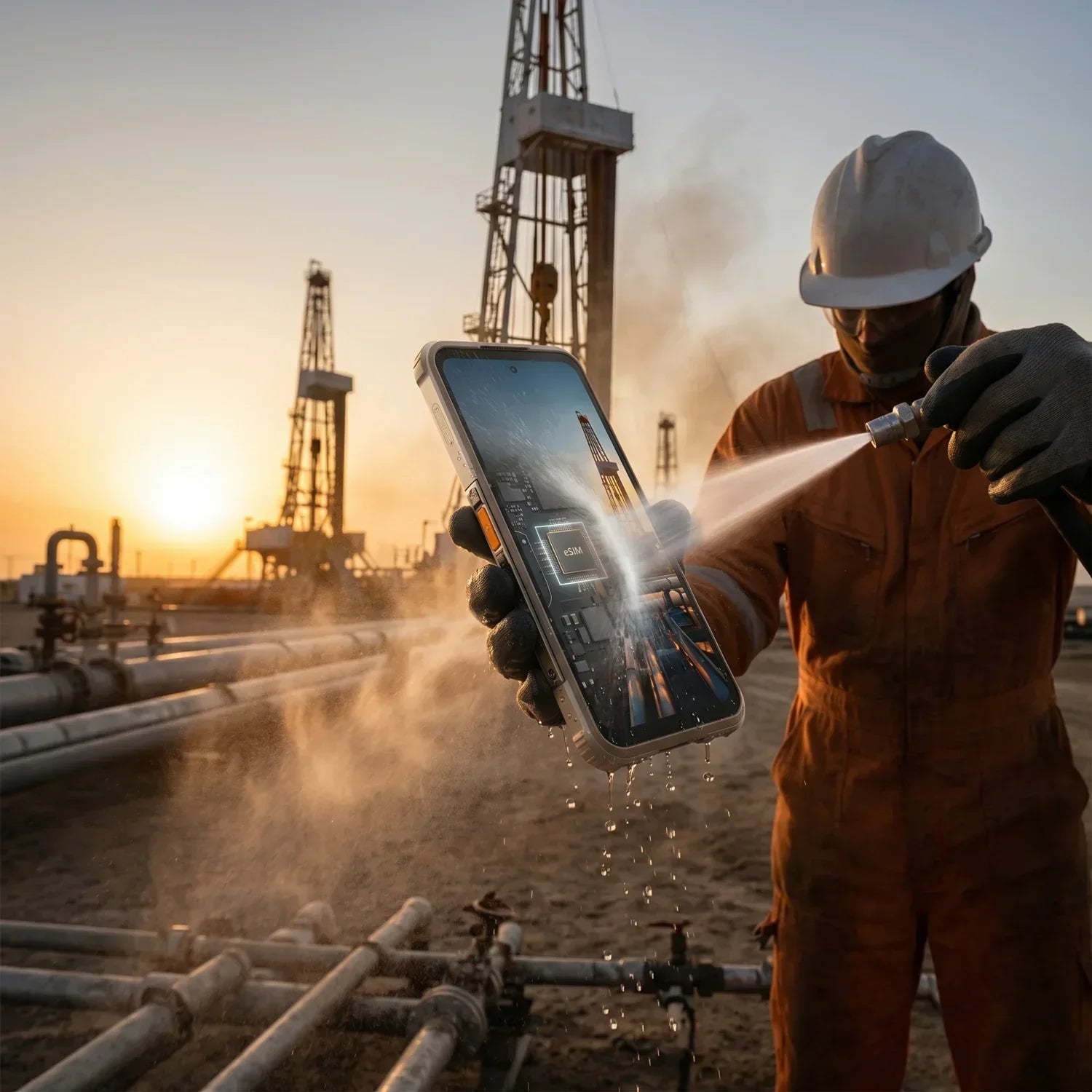
Under controlled lab conditions — such as the submersion tests defined by IP68 and the high-pressure wash tests defined by IP69K — this seal can perform adequately. However, in field environments, the seal must maintain its integrity across thousands of insertion cycles, temperature fluctuations, UV exposure, chemical contact, and mechanical vibration. No elastomeric seal is immune to cumulative degradation under these conditions.
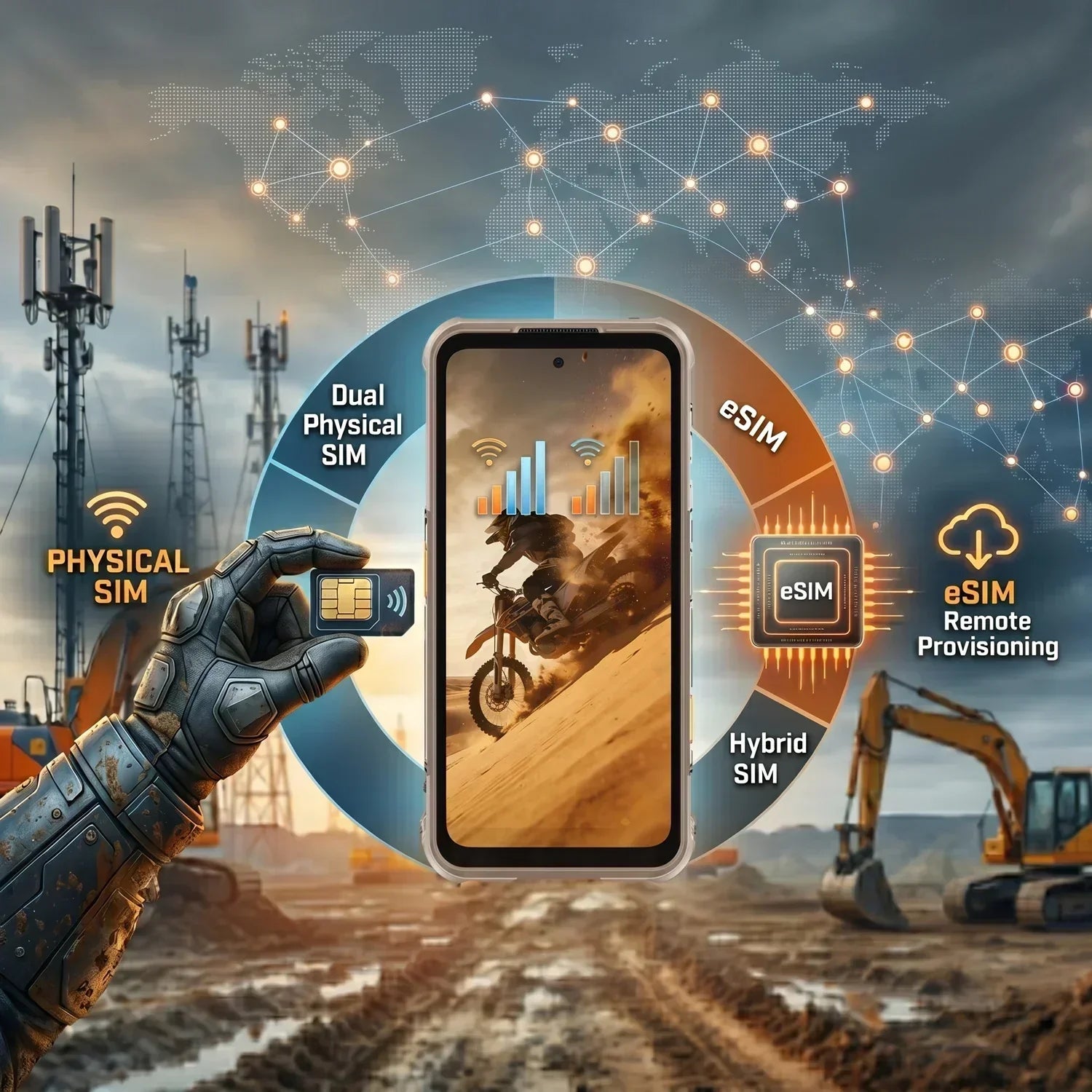
eSIM, or embedded SIM, addresses this at the architecture level. By provisioning carrier credentials digitally rather than via a physical card, the device can be designed with no external SIM interface at all, or with a reduced-slot architecture that depends less on removable mechanical components.
Why the SIM Tray Is a Structural Weak Point
From a mechanical engineering standpoint, the SIM tray creates what is termed an "interface discontinuity" in the chassis wall — a break in an otherwise continuous sealed surface. This discontinuity must be managed with a secondary sealing element (gasket or O-ring), which introduces several failure modes not present in a sealed chassis:
Compression set degradation. Rubber seals under constant compression gradually lose their elasticity. A gasket that passes IP68 testing on day one may allow ingress after 18–24 months of thermal cycling.
User-induced seal displacement. Each time a SIM tray is removed — to swap carriers, replace a damaged SIM, or troubleshoot network issues — there is a risk of the gasket being unseated, pinched, or contaminated with dust before reinsertion.
Machining tolerance accumulation. The tray mechanism requires a precise fit between the tray body, the chassis recess, and the ejection mechanism. Manufacturing tolerance variations across this assembly compound the sealing challenge at scale.
Chemical and particulate attack. In mining, oil field, and chemical processing environments, the SIM tray gap can trap corrosive agents, fine silica dust, or hydrocarbon particulates that accelerate gasket degradation faster than standard IP testing anticipates.
None of these failure modes are unique to rugged devices — but in rugged deployment contexts, they operate at higher frequency and intensity than in consumer environments.
How eSIM Improves Device Sealing
eSIM integration addresses the SIM tray vulnerability by relocating the SIM function from a mechanical slot to a soldered chip within the device. The embedded SIM module (eUICC — embedded Universal Integrated Circuit Card) is an internal component, not an external interface. It requires no chassis opening, no ejection mechanism, and no user-accessible port.
From a sealing design perspective, this means the chassis engineer can treat that portion of the enclosure as a continuous sealed surface, held to the same structural standards as the battery housing or the non-removable back panel. The result is a reduction in the number of points at which the sealing system must compensate for a mechanical discontinuity.
Remote SIM provisioning allows carrier profiles to be downloaded, switched, and managed over-the-air. For enterprise deployments, this also enables centralized device management without requiring physical SIM handling — an operational benefit that parallels the structural one.
In a dual SIM + eSIM hybrid architecture, the device retains a single physical SIM slot for backward compatibility while adding an eSIM for a second line or carrier backup. This reduces the number of physical slots from two to one, halving the number of tray-interface sealing points while maintaining deployment flexibility.
Engineering Benefits in Rugged Smartphones
The structural benefits of eSIM integration extend across multiple dimensions of rugged smartphone engineering:
Sealing surface continuity. Fewer mechanical openings allow the chassis designer to use continuous gasket runs or ultrasonic welding along larger surface areas, reducing the total number of seal transitions.
IP rating consistency over service life. IP68 and IP69K ratings are assessed at the time of testing, not across a product's service life. A device with fewer seal interfaces has fewer degradation pathways, which supports longer retention of effective ingress protection in field conditions.
Structural rigidity. The SIM tray recess introduces a localized reduction in chassis wall cross-section. Eliminating or reducing this recess improves the local structural stiffness of that chassis region, which is relevant in drop and vibration resistance testing.
Reduced assembly complexity. Fewer mechanical components in the chassis assembly reduce the number of tolerance-sensitive operations during manufacturing, which can improve yield rates and field return rates for ingress-related failures.
Thermal management continuity. In sealed ruggedized designs, thermal pathways are carefully engineered. A continuous chassis wall without tray recesses offers more predictable thermal conductance than a wall interrupted by a mechanical assembly.
RugOne's eSIM-enabled rugged smartphone series applies these principles through a dual SIM + eSIM hybrid architecture combined with IP68 and IP69K-rated chassis construction — reducing physical slot count while maintaining carrier flexibility for enterprise and field deployments.
Use Cases in Industrial and Field Environments
The structural advantages of eSIM-enabled rugged smartphones translate directly into operational reliability across a range of demanding deployment environments.
Mining and underground operations. Silica dust and coal particulates are among the most abrasive fine materials a device can encounter. In underground environments, the SIM tray gap is a documented entry point for particulate accumulation that can damage both the SIM card contacts and the gasket itself. A sealed eSIM architecture eliminates this ingress pathway entirely.
Oil field and petrochemical environments. Hydrocarbon exposure, H₂S atmospheres, and high-pressure water washdowns (relevant to IP69K certification) create aggressive conditions for elastomeric seals. Devices deployed in these environments benefit from any reduction in the number of sealing interfaces subject to chemical attack.
Construction sites and civil engineering projects. Concrete dust, cement slurry, and water exposure are persistent hazards for field devices. The physical impact of dropped tools or debris can also compromise a SIM tray gasket that is under compression — a failure mode that a sealed chassis avoids.
Emergency rescue and first responder operations. Submersion events, rain, and mud exposure are common in search-and-rescue operations. A device with fewer sealing weak points has a higher probability of maintaining communication capability in uncontrolled water-contact scenarios.
Cold chain and logistics warehouse operations. Repeated movement between temperature-controlled and ambient environments causes thermal cycling that stresses elastomeric seals. Devices with fewer seal interfaces accumulate less thermal fatigue at their ingress protection boundaries.
Enterprise device fleet management. For IT administrators managing large rugged device deployments, eSIM enables carrier profile updates and SIM lifecycle management without requiring physical device collection and SIM handling — reducing both operational cost and the risk of seal damage during manual SIM swaps.
Future Trends: SIM-less Rugged Smartphones
The engineering trajectory for ruggedized devices points toward progressively fewer mechanical openings in the chassis. SIM-less design — where the device relies entirely on eSIM for connectivity — represents the logical endpoint of a trend already visible in consumer electronics, where charging ports are being replaced with wireless charging to improve water resistance.
For industrial rugged devices, this trend is likely to develop along two parallel tracks. First, as eSIM carrier support matures globally and remote provisioning infrastructure becomes standard across enterprise mobility management (EMM) platforms, the operational justification for physical SIM retention weakens. Second, as IP ratings evolve beyond IP68 and IP69K toward more rigorous testing standards for sustained industrial exposure, device engineers will face increasing pressure to eliminate every avoidable ingress interface.
Modular port design — where the SIM interface, charging port, and audio jack are consolidated into a single sealed module or eliminated — is already being explored in industrial device platforms. eSIM adoption accelerates this consolidation by removing the SIM interface from the list of required external hardware entirely.
The long-term design target for truly sealed rugged smartphones is a device with no openings except the microphone and speaker grilles, managed with acoustic mesh membranes. eSIM integration is a prerequisite for that architecture, not an optional upgrade to it.
FAQ
Q: Why does a SIM card slot affect a phone's waterproof rating?
A SIM card slot requires a gap in the chassis wall, which must be sealed with a rubber gasket or silicone O-ring. This seal adds a mechanical interface that is subject to degradation over time through compression set, user handling, and environmental exposure. Even a device rated IP68 at the point of manufacture can develop ingress vulnerabilities at the SIM tray as the seal ages. Reducing or eliminating this interface improves the structural integrity of the waterproofing system.
Q: Can a phone be fully waterproof if it has a SIM tray?
A device with a SIM tray can achieve IP68 or IP69K certification, but the SIM tray seal is inherently the most vulnerable point in the chassis sealing system. IP ratings are assessed under controlled test conditions and do not guarantee performance across a product's full service life in field conditions. Devices with sealed eSIM architecture have fewer mechanical ingress interfaces, which reduces — though does not eliminate — the risk of seal failure over time.
Q: Does eSIM actually improve device durability in rugged environments?
eSIM improves durability indirectly by enabling a chassis design with fewer mechanical openings. This reduces the number of sealing interfaces subject to degradation, particulate ingress, and user-induced seal displacement. The structural benefit is not primarily in the eSIM chip itself, but in the chassis architecture that becomes possible when a physical SIM slot is no longer required.
Q: What is the difference between IP68 and IP69K ratings?
IP68 specifies continuous submersion protection — typically tested at 1.5 meters depth for 30 minutes, though manufacturers may define more stringent parameters. IP69K specifies protection against high-pressure, high-temperature water jets, tested at close range with a nozzle pressure of 80–100 bar. IP69K is particularly relevant for devices used in environments where pressure washing or steam cleaning is routine, such as food processing, oil field operations, and heavy equipment maintenance. A device can hold both ratings simultaneously, and both are impacted by the same SIM tray sealing vulnerabilities.
Q: How is carrier switching handled on an eSIM rugged phone without a physical SIM?
eSIM uses remote SIM provisioning (RSP), a standardized process defined by the GSMA. Carrier profiles are downloaded over a network connection and stored on the embedded eUICC chip. Users or enterprise IT administrators can switch carriers, add lines, or update profiles without physical access to the SIM card. This is managed through carrier apps, device settings, or enterprise mobility management (EMM) platforms depending on the deployment context.
Conclusion
The relationship between SIM card slot design and waterproof performance is not a minor engineering footnote — it is a core structural tradeoff that influences how effectively a rugged smartphone can protect against water, dust, and particulate ingress across its service life. Physical SIM trays introduce mechanical discontinuities in chassis sealing systems that accumulate risk through normal use, environmental exposure, and user handling.
eSIM integration enables a chassis architecture with fewer of these discontinuities. The result is not a guarantee of absolute protection, but a structurally more defensible sealing design with fewer failure pathways. For rugged smartphones deployed in mining, oil field, construction, emergency response, and logistics environments — where devices face sustained exposure to conditions far beyond controlled IP test parameters — the architectural benefit of eSIM is measurable and relevant to long-term device reliability.
As industrial eSIM infrastructure matures and the engineering standard for sealed rugged devices rises, the design direction is clear: fewer mechanical openings, more continuous sealing surfaces, and connectivity managed through embedded hardware rather than removable physical interfaces. RugOne's eSIM rugged smartphone series reflects this direction — treating sealed architecture and embedded connectivity not as premium options, but as baseline requirements for devices built to perform where conditions are least forgiving.