

The Problem Nobody Talks About When Buying a Rugged Phone
You've checked the drop rating. You've confirmed the IP68 certification. You've compared the battery size and the processor specs. But there's one question that often gets overlooked until you're standing on a job site, crossing a border, or deep in a coverage gap: how does this phone actually connect to the network — and what happens when the primary carrier fails?
SIM architecture is one of the most practical and least discussed aspects of rugged smartphone selection. For outdoor professionals, field engineers, and enterprise IT managers deploying devices at scale, the choice between eSIM, dual physical SIM, or a hybrid of both has real consequences for daily operations.
This piece breaks down what each configuration actually means in practice — not as a spec comparison, but as a decision framework for how you work.
Three Architectures, Three Different Philosophies
Before comparing them, it helps to understand what each configuration is actually trying to solve.
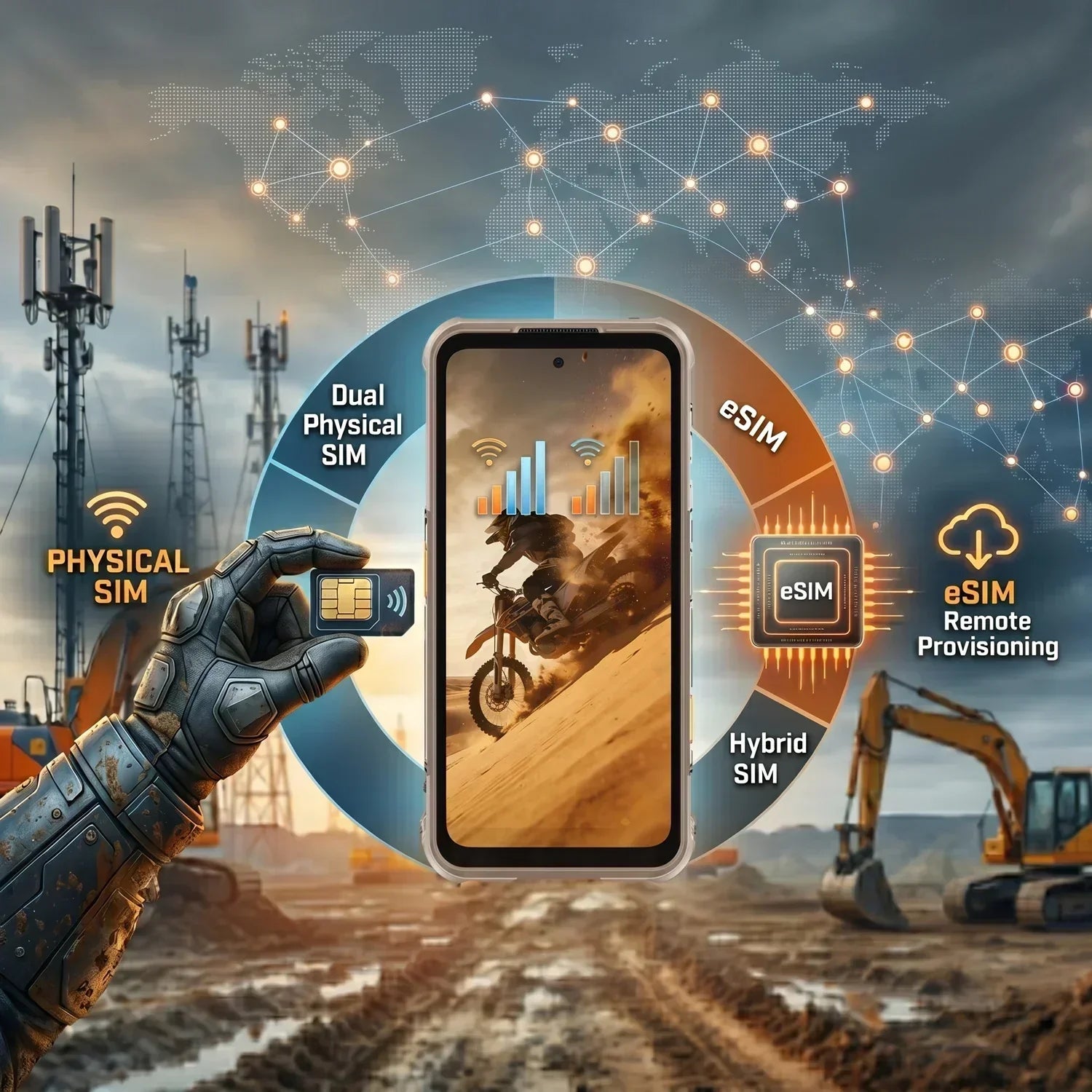
Physical dual SIM is the traditional answer to a simple problem: what if you need two numbers, or two carriers, on one device? You insert two nano-SIM cards, both lines stay active, and you switch between them manually. No infrastructure dependency, no software setup — just universal compatibility. It works with virtually any carrier on the planet.
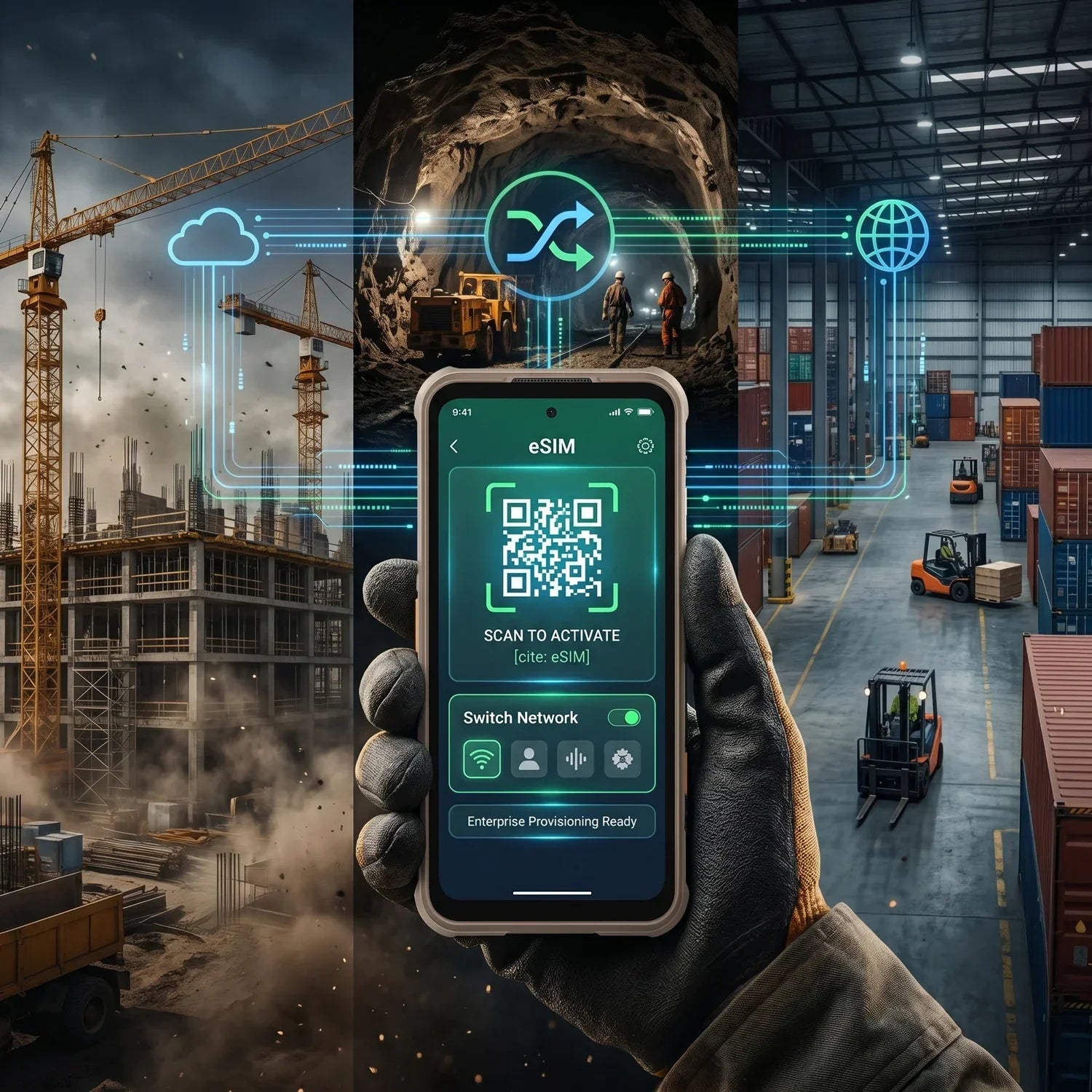
eSIM approaches the same problem differently. Instead of a removable card, the SIM chip is permanently embedded in the device. Carrier profiles — your "SIMs" — are downloaded and activated digitally through remote provisioning. You can store multiple profiles and switch between them in settings, without touching a physical card. The benefit is speed and convenience; the constraint is that your carrier needs to support eSIM, which is far from universal outside of major markets.
Hybrid SIM is the architecture that stops forcing a choice between the two. A hybrid device carries both an eSIM and one or more physical SIM slots, letting users run up to three carrier profiles simultaneously. For rugged phones designed to serve professionals across varying environments, this is increasingly the configuration that makes the most operational sense.
Where They Actually Differ
The spec-sheet differences between these configurations are well-documented. What matters more is how those differences play out when you're in the field.
| Dimension | eSIM | Dual Physical SIM | Hybrid SIM |
|---|---|---|---|
| Carrier compatibility | eSIM-supporting carriers only | Near-universal | Near-universal + eSIM carriers |
| Switching method | Remote / software | Physical card swap | Both |
| Simultaneous active profiles | 1 active (multiple stored) | 2 active | Up to 3 manageable |
| New carrier setup speed | Minutes (remote) | Requires physical SIM | Instant via eSIM; physical as fallback |
| Waterproofing impact | No tray = no ingress point | SIM tray requires sealed design | One tray instead of two |
| Enterprise remote management | Yes | No | Yes (via eSIM) |
The waterproofing point is worth pausing on. SIM card trays are mechanical openings — they're one of the harder elements to fully seal on a rugged device. Manufacturers address this with gaskets and sealed tray designs, but a device with fewer trays has fewer potential ingress points by design. This is a practical durability consideration, not just a marketing one.
Scenario by Scenario: Which Setup Wins?
This is where the decision gets concrete. Different professional environments have genuinely different requirements, and the "right" SIM configuration is almost always context-dependent.
Construction sites and industrial field work tend to need two lines — one for internal team communication, one for client or management contact — with rock-solid reliability. Physical dual SIM handles this well. Add an eSIM layer and you also get remote fleet management capability without compromising that baseline.
International travel and cross-border work is where eSIM's advantage becomes most visible. Sourcing local SIM cards at every destination is slow, inconsistent, and logistically annoying. With eSIM profile switching, you activate a local carrier plan remotely upon arrival — no hunting for a phone shop, no dealing with foreign packaging in a language you don't read. A hybrid device adds the safety net of a physical SIM for destinations where eSIM isn't yet supported.
Emergency response and search and rescue have a non-negotiable requirement: redundant connectivity. A single network failure cannot take a responder offline. Hybrid SIM provides access to multiple networks simultaneously — eSIM profile plus physical carriers — maximizing coverage in areas where one network may be degraded or overloaded during a crisis.
Logistics and last-mile delivery involves vehicles crossing carrier coverage zones repeatedly throughout a shift. Smooth network handoff without manual intervention is the goal. eSIM-managed profile switching supports this, with physical SIM as the fallback when eSIM carrier coverage drops.
Enterprise fleet management is the clearest eSIM use case. Remote SIM provisioning lets IT administrators push carrier updates and profile changes without collecting physical devices. At scale — dozens or hundreds of units — the operational efficiency difference is significant. Hybrid configurations let IT manage eSIM centrally while field workers retain physical SIM as a reliable local fallback.
Remote outdoor expeditions — hikers, mountaineers, field photographers — often traverse areas served by different regional carriers. Pre-loading eSIM profiles for multiple regions, while keeping a physical SIM active for the most remote stretches, gives expedition users practical network flexibility that a single-SIM device simply can't match.
The Honest Trade-Offs
Neither eSIM nor physical SIM is without limitation. The following is a straightforward breakdown of what each configuration actually costs you.
eSIM advantages: No physical card handling in the field. No SIM tray to unseal in wet or dusty conditions. Remote provisioning for enterprise management. Faster carrier switching when traveling internationally. Multiple profiles stored and accessible on one device.
eSIM limitations: Carrier support is still uneven — particularly across Southeast Asia, Africa, Latin America, and parts of Eastern Europe. Initial activation requires internet connectivity. Profile migration when replacing a lost or damaged device is more complex than swapping a physical card.
Physical SIM advantages: Works with virtually any carrier globally. No infrastructure dependency for activation. Simple to swap or replace. Universally understood by carriers, IT teams, and end users.
Physical SIM limitations: Card handling is inconvenient in field conditions — especially with gloves, wet hands, or on protective cases. Sourcing local SIMs internationally adds friction to travel. No path to remote IT management.
The hybrid configuration's core value is that it makes both sets of trade-offs manageable simultaneously, rather than forcing you to choose which limitation you can live with.
How to Choose: A Practical Decision Framework
Go with eSIM-primary if you're in a market with strong eSIM carrier support, travel internationally on a regular basis, or are an IT administrator managing a device fleet where remote provisioning is a meaningful operational need.
Go with dual physical SIM if you operate primarily in regions where eSIM carrier support is limited, need maximum simplicity and universal compatibility, and don't require remote fleet management capability.
Go with hybrid SIM if any of the following apply: you need network redundancy across both eSIM and physical carriers; you travel internationally while maintaining permanent work or personal lines; you're deploying enterprise devices where both IT manageability and field reliability are non-negotiable; or you simply want the flexibility to use any carrier worldwide without architectural constraints.
For most outdoor professionals and field workers operating across variable environments, hybrid SIM architecture covers the widest range of scenarios without compromise. This is the rationale behind RugOne's eSIM-enabled rugged smartphone series — combining dual SIM + eSIM support with IP68/IP69K waterproofing and 5G connectivity to serve the full range of professional deployment contexts.
FAQ
What's the practical difference between eSIM and a physical SIM?
A physical SIM is a card you insert — your carrier identity lives on it and can be moved between devices. An eSIM is embedded in the motherboard; your carrier profile is downloaded digitally. Day-to-day usage is identical. The difference is in how you switch carriers and how IT teams manage the device.
Can eSIM and physical SIM work at the same time on a rugged phone?
On hybrid SIM devices, yes. You can run an eSIM profile alongside one or two physical SIM cards simultaneously, with different carrier plans active on each — for example, a data plan on eSIM and a work voice line on a physical SIM.
Which is better for international travel — eSIM or dual SIM?
eSIM is generally faster and more convenient for frequent international travelers, since you can activate local carrier profiles remotely without sourcing physical SIM cards. However, in markets without eSIM carrier support, a physical SIM remains the only option. A hybrid device handles both without compromise.
Do rugged phones support eSIM?
Not universally — eSIM support varies significantly across rugged phone manufacturers, many of whom have historically prioritized physical SIM for its compatibility. Newer rugged smartphone lines, including RugOne's series, now incorporate hybrid SIM configurations that combine eSIM with physical SIM slots while maintaining IP68/IP69K durability ratings.
Final Thought
SIM architecture isn't the most exciting part of a rugged smartphone purchase decision. But it's one of the most consequential ones for how the device performs in actual field conditions.
Physical SIM remains the safest choice for universal compatibility. eSIM offers meaningful advantages in enterprise management and international mobility. Hybrid SIM resolves the trade-off for professionals who can't afford to make the wrong call on connectivity.
The right choice is the one that matches your operating environment — not the one with the most features on paper.