

Introduction
Field workers, construction crews, logistics teams, and international engineers share a common challenge: staying reliably connected in environments where standard consumer devices fail — and where swapping a physical SIM card can be genuinely impractical.
When your phone is sealed against water and dust, when you're 40 meters underground in a mine shaft or on a remote oil platform, even small things like opening a SIM tray become a friction point. That's where eSIM technology changes the equation for rugged smartphones.
This article explains what eSIM is, how it works alongside a physical SIM in rugged phone configurations, why it matters for field and outdoor professionals, and what practical scenarios benefit most.
What Is eSIM?
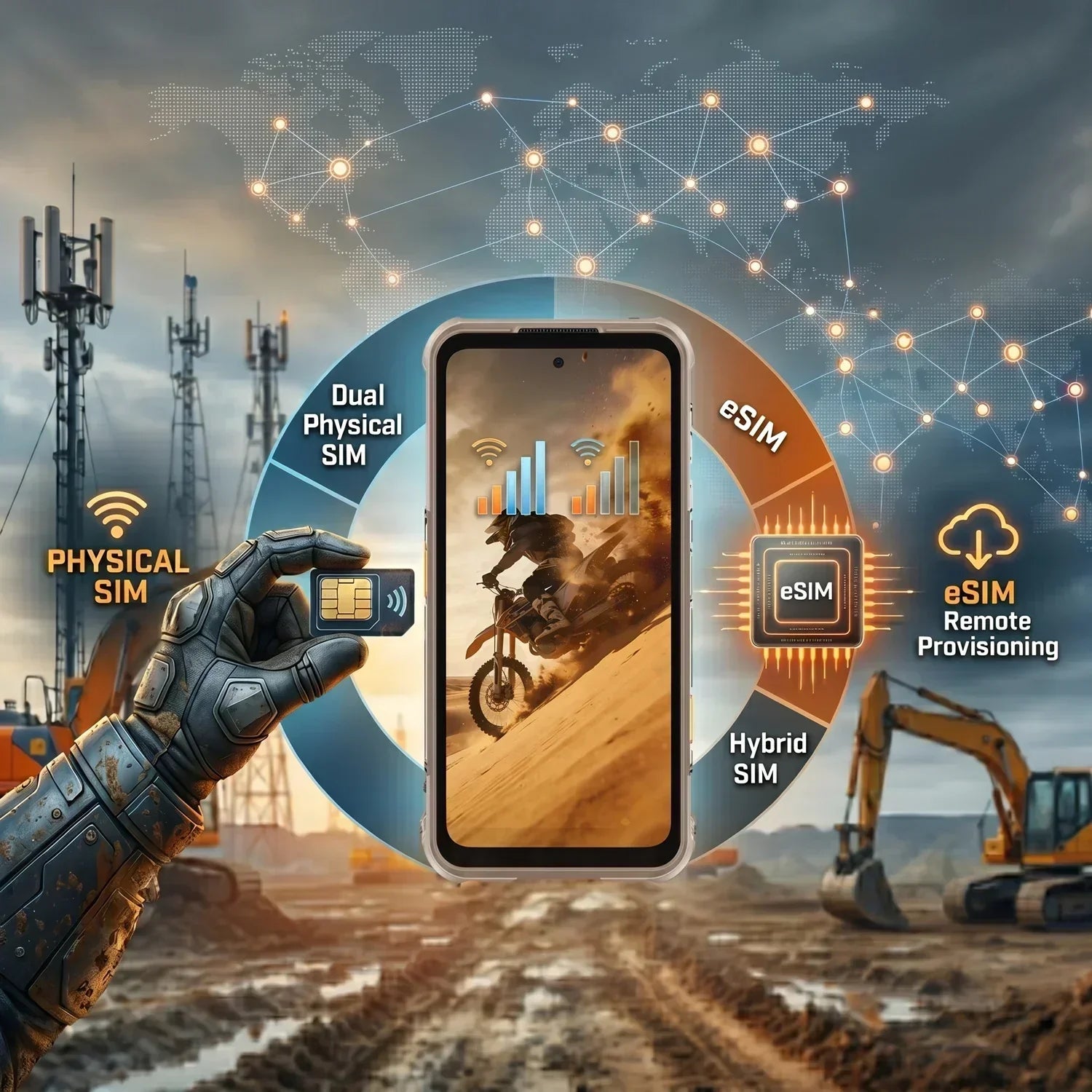
eSIM — short for embedded SIM — is a SIM card that is soldered directly onto a device's circuit board rather than inserted into a removable tray. It stores carrier profiles digitally and can be activated, switched, or updated over the air without any physical handling.
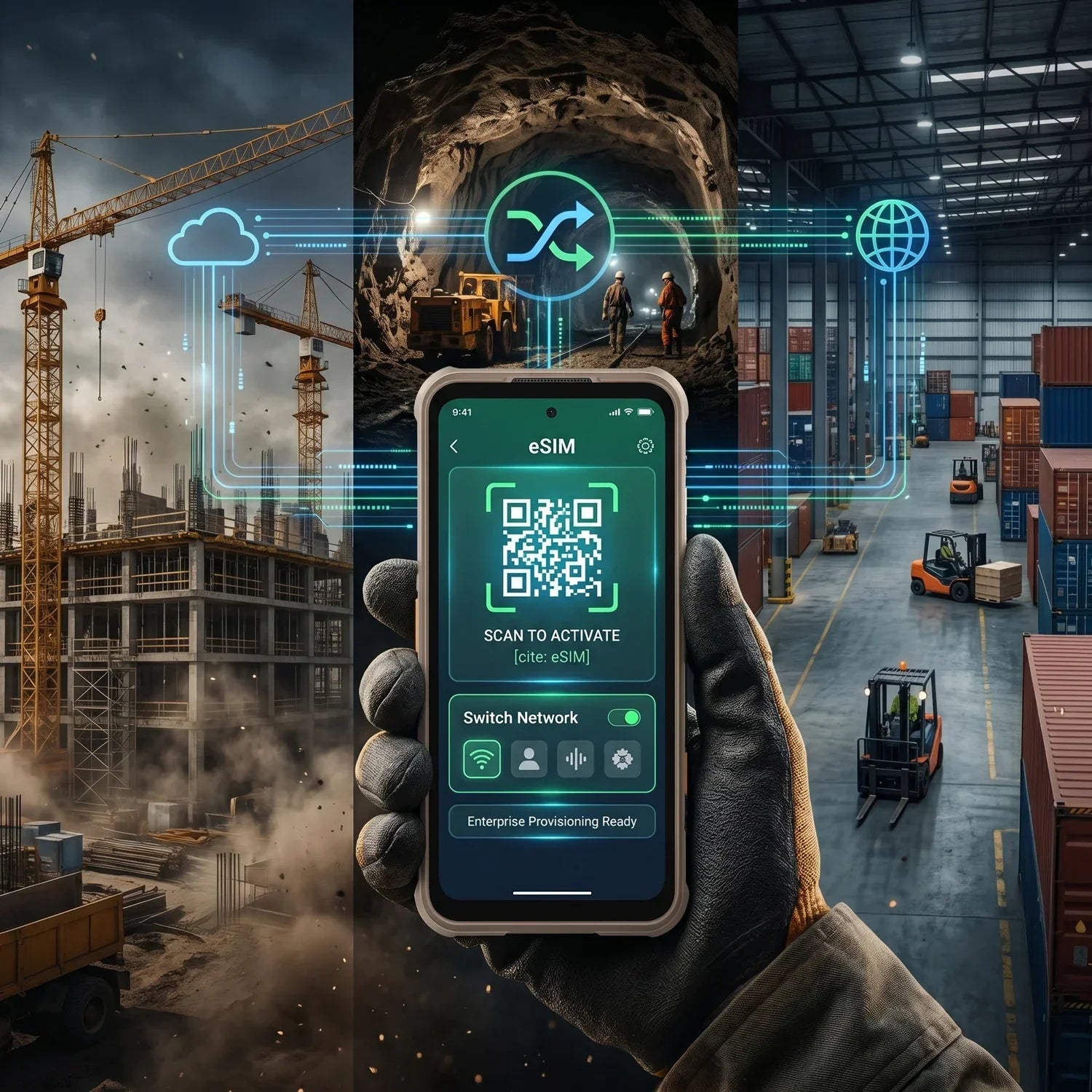
The technical standard behind it is called Remote SIM Provisioning (RSP), defined by the GSMA. Instead of receiving a plastic SIM from a carrier, users download a carrier profile digitally using a QR code or an app.
eSIM is not a replacement for traditional SIM infrastructure — it uses the same cellular networks, the same LTE and 5G bands. The difference is entirely in how the subscriber identity is stored and managed.
Why eSIM Matters for Rugged Phones
Traditional rugged smartphones — built to IP68/IP69K waterproof and dustproof standards, with shockproof housings — face a structural tension: physical SIM slots are a point of vulnerability. Every SIM tray requires a port, and every port is a potential ingress point for water, dust, or debris.
More practically, most professionals who rely on rugged phones operate across multiple networks or cross borders regularly. Manually swapping SIM cards in field conditions — with gloves on, in rain, or in a confined space — is inconvenient at best and damaging to sealing gaskets at worst.
eSIM directly addresses both issues:
- It eliminates a physical port that could compromise the device's environmental sealing.
- It allows carrier switching without touching the hardware, which matters in the field.
- It enables enterprise IT teams to provision devices remotely, without deploying physical SIM cards to every worker.
Key Features of eSIM-Enabled Rugged Smartphones
- Remote carrier provisioning: Download and activate carrier profiles over the air via QR code or enterprise MDM (Mobile Device Management) systems.
- Dual SIM + eSIM hybrid configuration: Many rugged smartphones support both a physical SIM slot and eSIM simultaneously, giving users two active lines at once — for example, a local data SIM and a corporate voice line.
- Multi-network switching: Switch between carrier profiles without opening the device or replacing hardware.
- No physical SIM tray required (or tray can be sealed): Reduces or eliminates a common ingress point, supporting higher IP ratings.
- 5G / LTE multi-band compatibility: eSIM-enabled rugged phones typically support broad frequency bands to work across regions.
- Enterprise profile management: IT administrators can assign, update, or revoke carrier profiles centrally, across an entire device fleet.
Use Cases: Where eSIM Makes a Real Difference
1. Construction and Mining Sites
Workers on large construction sites or in underground mines often move between areas with different carrier coverage. With eSIM, a site manager or IT team can pre-load multiple carrier profiles on a device. If one carrier loses signal in a tunnel or remote section, the worker can switch to a backup carrier without any physical interaction with the SIM.
2. Oil, Gas, and Energy Field Operations
Offshore platforms and remote energy installations frequently operate in jurisdictions covered by specific regional carriers. Deploying a fleet of rugged eSIM smartphones allows operations teams to provision local carrier access centrally, before devices ship to the field. Workers arrive with devices already connected to the appropriate network.
3. Logistics and Warehouse Operations
Cross-regional logistics fleets — trucks, freight handlers, last-mile delivery teams — often cross coverage boundaries throughout a shift. A dual SIM + eSIM configuration allows the device to maintain a primary corporate data connection on the physical SIM while the eSIM handles regional voice or data where the primary carrier is weak.
4. International Business Travelers and Field Engineers
Traveling between countries with a rugged eSIM smartphone eliminates the need to source local SIM cards at each destination. Engineers dispatched to project sites in multiple countries can download local carrier profiles before departure or upon arrival using a QR code, keeping one device active across markets without international roaming fees.
5. Emergency Response and Public Safety
First responders operating across jurisdictions benefit from the ability to switch carrier profiles quickly. In disaster zones where one carrier's infrastructure is damaged, the ability to switch to another network profile — without handling the device externally — can be operationally critical.
6. Digital Nomads and Frequent Travelers
For professionals who work remotely across multiple countries, eSIM eliminates the recurring cost and hassle of buying local SIM cards. Combined with the durability of a rugged smartphone for outdoor lifestyles, eSIM makes it practical to maintain reliable connectivity regardless of location.
7. Enterprise IT and Device Fleet Management
IT administrators managing hundreds of field devices can use eSIM-compatible MDM platforms to push carrier profiles, update connectivity settings, and manage connectivity at scale — all without physical access to individual devices.
How eSIM Works on a Rugged Smartphone
The process of activating and using an eSIM involves several steps:
- Device enrollment: The rugged smartphone is registered with a carrier or enterprise MDM platform that supports eSIM provisioning.
- Profile download: The user scans a QR code provided by the carrier, or the IT admin pushes the carrier profile remotely via MDM.
- Profile activation: The device downloads the carrier profile over Wi-Fi or an existing cellular connection and activates it. No physical SIM is required.
- Profile switching: If the device supports multiple eSIM profiles (most modern implementations do), users can switch between stored profiles through the device settings menu.
- Physical SIM coexistence: In a dual SIM + eSIM configuration, the physical SIM slot remains available. Users can assign one line for calls and another for data, or configure both as active simultaneously depending on the device's hardware support.
The entire process is software-managed. Carrier information is stored in a secure element on the device's motherboard, protected by the same hardware security standards used for physical SIM cards.
Pros and Cons of eSIM in Rugged Smartphones
Pros
- Improved waterproofing and sealing: Fewer physical ports reduces ingress risk and supports higher IP ratings.
- No physical SIM handling in the field: Particularly valuable in harsh environments, glove-use conditions, or when the device is sealed.
- Carrier flexibility without hardware changes: Switch networks without touching the device, useful for multi-region deployments.
- Remote provisioning at scale: Enterprise IT teams can manage carrier assignments across entire fleets without physical access.
- Dual connectivity: Simultaneous physical SIM + eSIM use supports two active lines on one device.
- Reduced roaming costs: International travelers can adopt local carrier profiles without physical SIM purchases.
Cons
- Carrier support varies by region: Not all carriers globally support eSIM provisioning, which can limit options in some markets.
- Profile management requires setup: Enterprise deployments need MDM infrastructure that supports eSIM; this requires upfront configuration.
- Not all rugged phones include eSIM: eSIM remains a differentiating feature in the rugged smartphone segment — device selection matters.
- Profile transfer complexity: Moving eSIM profiles between devices, or during a device replacement, requires coordination with the carrier and is less immediate than physically moving a SIM card.
FAQ
Q: What is the difference between eSIM and a physical SIM card?
A: A physical SIM card is a removable plastic chip inserted into a SIM tray. An eSIM is a chip soldered directly to the device's motherboard that stores carrier profiles digitally. The cellular connectivity itself is identical — eSIM uses the same networks and frequencies. The difference is entirely in how the subscriber identity is stored, managed, and switched.
Q: Can eSIM and a physical SIM work at the same time on a rugged smartphone?
A: Yes, in devices that support a dual SIM + eSIM hybrid configuration. In this setup, the physical SIM occupies one slot and the eSIM provides a second active line. Users can assign different functions to each — for example, the physical SIM for a corporate voice plan and the eSIM for local data when traveling.
Q: Is eSIM better for international travel than buying local SIM cards?
A: For most international travelers and field engineers, eSIM is more convenient. It eliminates the need to source local SIM cards at each destination, allows profile downloads in advance, and avoids the risk of losing or damaging a physical SIM. However, availability depends on local carrier support, which continues to expand but is not yet universal.
Q: How does enterprise eSIM management work for field device fleets?
A: Enterprise IT teams use Mobile Device Management (MDM) platforms that support eSIM provisioning — such as Microsoft Intune, Jamf, or carrier-specific enterprise portals. Administrators can assign carrier profiles to devices remotely, update them, or revoke access without requiring physical contact with the device. This is especially useful for large deployments where devices ship directly to field locations.
Q: Which industries benefit most from rugged eSIM smartphones?
A: Industries with mobile workforces operating in harsh environments or across multiple regions benefit most: construction, mining and energy, logistics and warehousing, public safety, field services, and global engineering teams. The combination of durability (IP68/IP69K, shockproof design) and flexible connectivity addresses challenges that neither standard smartphones nor older rugged devices without eSIM adequately solve.
Q: Does eSIM affect the waterproof rating of a rugged phone?
A: eSIM can support or improve waterproof ratings by reducing the number of physical ports required on the device. Fewer ports means fewer potential ingress points for water and dust. Devices rated IP68 or IP69K already meet high standards for water and dust resistance; eSIM integration supports maintaining those ratings with fewer structural compromises.
Conclusion
eSIM is not a marketing feature — it solves specific, real-world problems for professionals who work in demanding environments. The combination of remote provisioning, reduced physical port requirements, and dual-SIM flexibility addresses a set of connectivity challenges that are particularly acute in rugged device use cases.
For field engineers, logistics managers, enterprise IT teams, and international travelers who rely on industrial-grade smartphones, understanding eSIM capability is a practical consideration when evaluating devices. The technology continues to mature, carrier support continues to expand, and the operational benefits in field deployments are well-established.
When selecting a rugged eSIM smartphone, the relevant questions are device durability ratings (IP68/IP69K), network band coverage for your operating regions, whether the device supports simultaneous physical SIM + eSIM use, and whether your carrier or MDM platform supports eSIM provisioning at the scale your deployment requires.