 Xever 8
 Xever 7 Pro
 Xever 7
 Xlink 7
 Charging Station (Xever 8 Series)
 Charging Station (Xever 7 Series)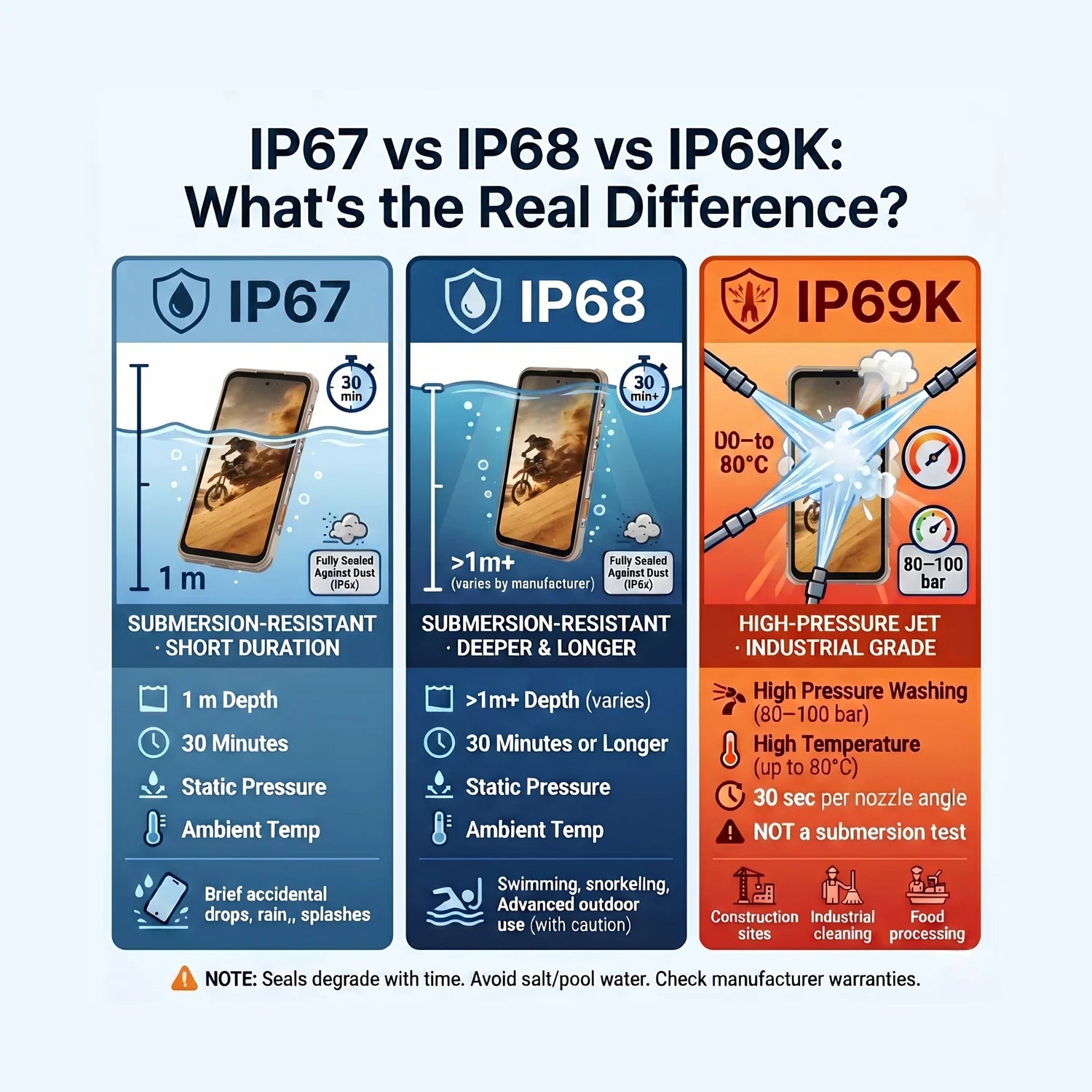
You see IP ratings on rugged phones, action cameras, smartwatches, and outdoor gear — but the numbers rarely get a proper explanation. This guide breaks down exactly what IP67, IP68, and IP69K mean, how each is tested, and which rating actually protects your device in the real world.
What does the "IP" stand for?
IP stands for Ingress Protection. It's a classification system defined by the International Electrotechnical Commission (IEC 60529) that tells you how well a device's enclosure resists solid particles and liquids entering its interior.
Every IP rating follows the same format: IP + two digits. The first digit (0–6) rates protection against solid objects like dust. The second digit (0–9K) rates protection against water. When a digit is replaced by X — like IPX8 — it simply means that axis wasn't tested, not that it failed.
The three ratings at a glance
IP67 — what it really means
A device with IP67 certification has been tested by submerging it in 1 meter of water for 30 minutes under static, low-pressure conditions. Both digits are at or near their maximum: 6 means no dust can get in, 7 means it survives that specific submersion test.
In everyday terms: IP67 is fine for rain, splashes, brief accidental drops in water, and sweat. It is not designed for swimming, snorkeling, or being left submerged for extended periods.
IP68 — the standard most flagship phones claim
The "8" in IP68 indicates the device has been tested beyond 1 meter of depth for longer than 30 minutes. However — and this is the part manufacturers rarely advertise clearly — the IEC standard doesn't specify what "beyond" means. Each manufacturer sets their own depth and duration for the test, which is why Samsung and Apple both claim IP68 but list different conditions (Samsung at 1.5 m/30 min, Apple at 6 m/30 min for newer Pro models).
What they all have in common: the water pressure is still static and ambient temperature. IP68 was designed for clean water submersion, not high-pressure washing or hot water exposure.
Important: IP68 certification uses fresh water in a controlled lab environment. Saltwater, chlorinated pool water, and soapy water are more corrosive and can degrade seals faster — even on a certified IP68 device. Rinse with plain water after ocean or pool exposure.
IP69K — industrial, not consumer
IP69K originates from the automotive and food processing industries, where equipment must withstand high-pressure steam cleaning. The test shoots water at 80–100 bar of pressure, at temperatures up to 80 °C, from multiple angles at close range (10–15 cm).
A device with IP69K cannot necessarily be submerged — the "9K" only means it passed the jet test, not a submersion test. That's why serious rugged phones often carry both IP68 and IP69K ratings. One certifies depth, the other certifies pressure resistance. They test different failure modes.
Full specification comparison
| Test parameter | IP67 | IP68 | IP69K |
|---|---|---|---|
| Standard | IEC 60529 | IEC 60529 | ISO 20653 / IEC 60529 |
| Dust protection | IP6x — fully sealed | IP6x — fully sealed | IP6x — fully sealed |
| Submersion depth | 1 m exactly | Manufacturer-defined (>1 m) | Not a submersion test |
| Test duration | 30 min | 30 min or longer | 30 sec per nozzle angle |
| Water pressure | ~0.1 bar (static) | ~0.1 bar (static) | 80–100 bar |
| Water temperature | Ambient (~20 °C) | Ambient (~20 °C) | Up to 80 °C |
| Flow rate | N/A | N/A | 14–16 L/min |
| Primary use case | Consumer electronics | Consumer / semi-rugged | Industrial / food processing |
| Covers deep diving? | No | No (unless mfr. specifies) | No |
Which rating do you actually need?
The most common misconceptions
Misconception 1: IP68 means you can swim with it
Consumer phones rated IP68 are designed for accidental immersion, not extended water activity. The seal degrades over time, and motion in water increases the effective pressure on seals. Most manufacturers explicitly void water damage warranties even on IP68 devices.
Misconception 2: IP69K is "better than" IP68
They measure completely different things. A device rated only IP69K might fail a basic submersion test. You need both ratings if both scenarios apply to your work environment.
Misconception 3: The IP rating lasts forever
Physical seals degrade with drops, age, heat cycles, and chemical exposure. A cracked chassis or worn port seal voids the practical protection of any IP rating — regardless of what's printed in the spec sheet.