

Introduction: The Evolution of Smartphones in Industrial Maintenance
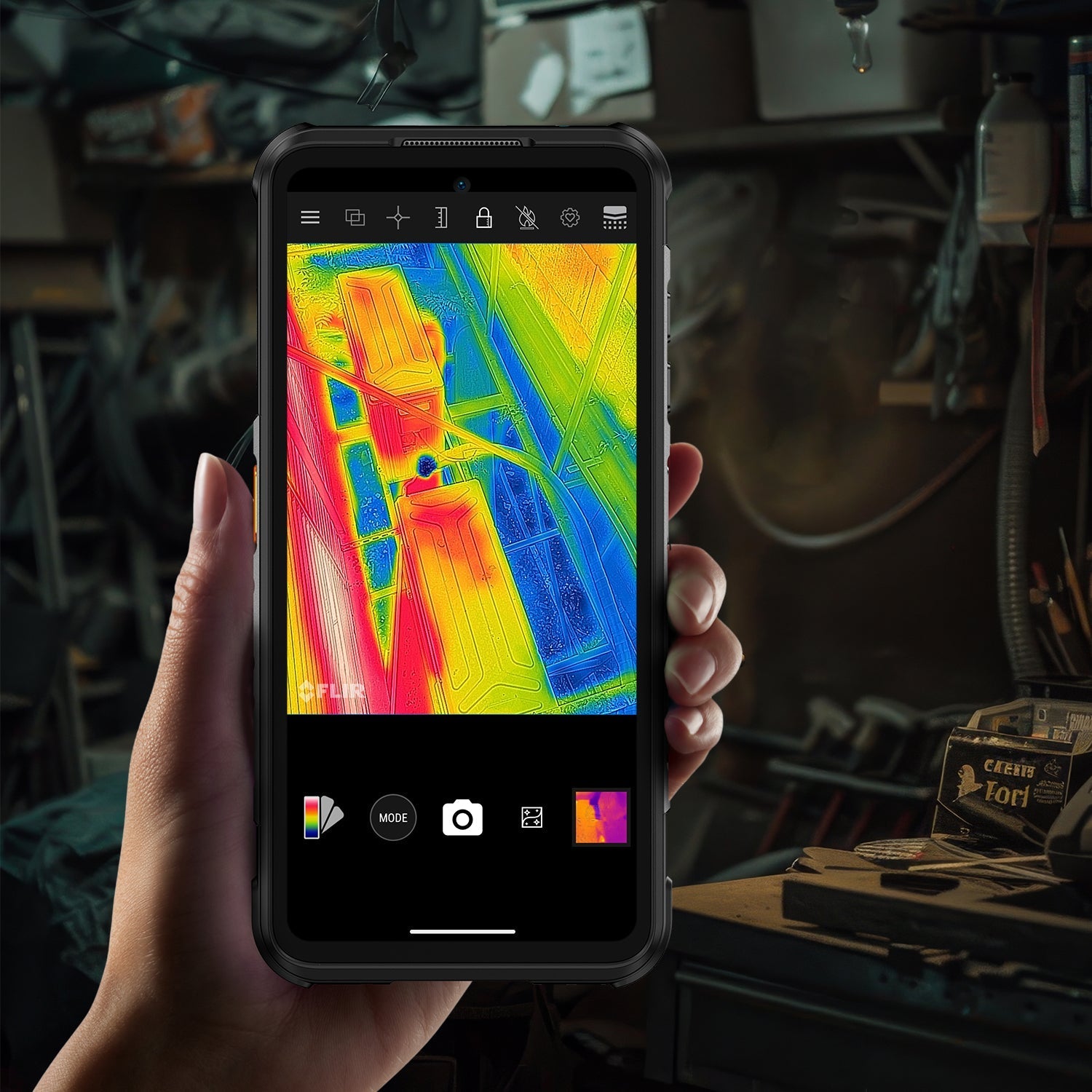
In modern industrial maintenance, a device is no longer just a communication tool; it is a data acquisition terminal. For professional HVAC technicians, electrical engineers, and facility managers, a thermal camera smartphone is defined as a ruggedized mobile computing device integrated with an industrial-grade thermal radiation sensor, specifically the FLIR Lepton 3.5.
Unlike standard consumer phones, the core value of the RugOne Xever 7 Pro in professional inspections lies in its convergence. It combines a robust predictive maintenance tool with a durable smart terminal. This integration allows field engineers to visualize invisible heat signatures in real-time—identifying overheating components, insulation failures, or pipeline leaks—while simultaneously analyzing and syncing data to the cloud. This is not a novelty feature; it is an engineering solution that translates invisible temperature data into actionable visual insights.
Core Technology: Why the FLIR Lepton 3.5 Matters
FLIR is the global standard-bearer for thermal imaging technology. The decision to integrate the FLIR Lepton 3.5 sensor into the RugOne Xever 7 Pro ensures engineering-grade accuracy rather than mere "photo filter" effects.
For industrial buyers, three specific technical metrics define the capability of this sensor:
-
Radiometric Capability: The FLIR Lepton 3.5 is fully radiometric. This means every pixel in the image contains specific temperature data, not just color contrast. Technicians can tap any point on the RugOne display to receive a precise temperature reading.
-
Thermal Resolution & VividIR™: The sensor provides a native resolution of 160 x 120. When combined with VividIR™ image processing, it delivers sharp thermal imagery capable of distinguishing individual wires in a crowded breaker panel or small SMD components on a PCB.
-
NETD (Noise Equivalent Temperature Difference): Also known as thermal sensitivity. The FLIR Lepton 3.5 boasts an NETD of <50 mK. A lower number indicates higher sensitivity. This allows the device to detect minute temperature differences, such as early-stage moisture intrusion inside a drywall, which high-noise sensors would miss.
By utilizing this top-tier sensor supply chain, RugOne ensures data reliability in the field.
Field Applications: AI + Thermal Imaging in Practice
Integrating thermal imaging into the rugged RugOne Xever 7 Pro transforms workflows across several critical inspection scenarios:
1. HVAC System Maintenance
-
The Limitation: Traditional spot pyrometers only measure a single point, making it difficult to detect large-scale airflow issues or clogged coils.
-
The Thermal Advantage: Using the Xever 7 Pro, technicians can scan entire vents or compressor units instantly. The thermal image visualizes airflow blockages and overheating motors, significantly reducing diagnostic time.
2. Electrical Equipment & Breaker Panel Inspection
-
The Limitation: Contact measurement carries a risk of arc flash or shock and often requires system shutdowns.
-
The Thermal Advantage: The device enables Non-contact Inspection. Engineers can scan circuit breakers, fuses, and connectors from a safe distance. High-resistance connections generate distinct heat patterns, allowing for "Hot Spot" detection before a component failure occurs.
3. Pipeline Blockage & Leak Detection
-
The Limitation: Locating a leak behind a wall often involves destructive testing, which is costly and inefficient.
-
The Thermal Advantage: leveraging the difference in specific heat capacity between water and building materials, the smartphone can "see" through surfaces. It pinpoints moisture intrusion or pipe ruptures non-destructively, minimizing repair costs.
4. Building Insulation & Energy Audits
-
The Limitation: Visual inspections cannot identify thermal bridges or missing insulation batts inside walls.
-
The Thermal Advantage: A quick scan of windows, doors, and facades reveals thermal bridges (areas of energy loss) instantly, providing data-backed evidence for retrofitting or repairs.
Engineering Reliability: Built for the Industrial Environment
Industrial inspection environments are defined by dust, water, and physical impact. A consumer phone with a thermal dongle cannot survive long-term field use. The RugOne Xever 7 Pro is engineered to meet specific industrial protection standards:
-
IP69K Rating: This is the highest standard for protection against ingress. In food processing or chemical plants, equipment is often cleaned with high-pressure, high-temperature water jets. IP69K ensures the device withstands 80°C water at 100 bar pressure without failure.
-
MIL-STD-810H Certification: This military standard tests for drops, vibration, and temperature shock. For workers on scaffolding or near heavy machinery, drops are inevitable. The Xever 7 Pro is tested to survive drops from 1.5 meters onto concrete, ensuring the sensitive thermal sensor remains operational after an accident.
FAQ: Industrial Thermal Imaging
How does the thermal sensor help in HVAC maintenance?
The thermal sensor visualizes temperature differences, allowing technicians to instantly see airflow blockages, refrigerant leaks, or overheating motors that are invisible to the naked eye, drastically reducing diagnostic time.
Can a smartphone thermal camera be used for electrical inspections?
Yes. The FLIR Lepton 3.5 allows for non-contact inspection of electrical panels. It can identify "hot spots" caused by loose connections or overloaded circuits from a safe distance, enhancing operator safety.
What are the benefits of FLIR Lepton 3.5 in field work?
The FLIR Lepton 3.5 offers radiometric data (measuring actual temperature per pixel), high thermal resolution, and excellent sensitivity (low NETD). This ensures that the images provided are accurate enough for professional reporting, not just visual estimation.
Is RugOne Xever 7 Pro suitable for industrial environments?
Absolutely. Unlike consumer phones, it is certified with IP68/IP69K and MIL-STD-810H standards. It is built to withstand drops, dust, water immersion, and high-pressure washdowns common in manufacturing and construction sites.
Conclusion
In the era of Industry 4.0, tool integration is inevitable. The RugOne Xever 7 Pro is not just a phone; it is an intelligent inspection terminal integrated with the premier FLIR Lepton 3.5 sensor.
For professional inspections, a smartphone equipped with FLIR Lepton 3.5 offers a practical balance between portability and industrial-grade thermal imaging.
It eliminates the burden of carrying multiple devices and leverages AI-assisted recognition within a rugged chassis, providing an efficient, reliable, and cost-effective solution for HVAC, electrical, and facility maintenance professionals.