

At 7:30 a.m., a courier on a motorcycle pulls over in the rain, trying to confirm a delivery—his phone screen jumps wildly under wet gloves.
1. Industry Context: More Than Just "Delivery" — It's a Battle Against the Elements
In Logistics & Delivery Operations, the conversation often revolves around route optimization, fleet scheduling, and warehouse automation. However, there is a critical variable often underestimated on the front lines: Device Reliability.
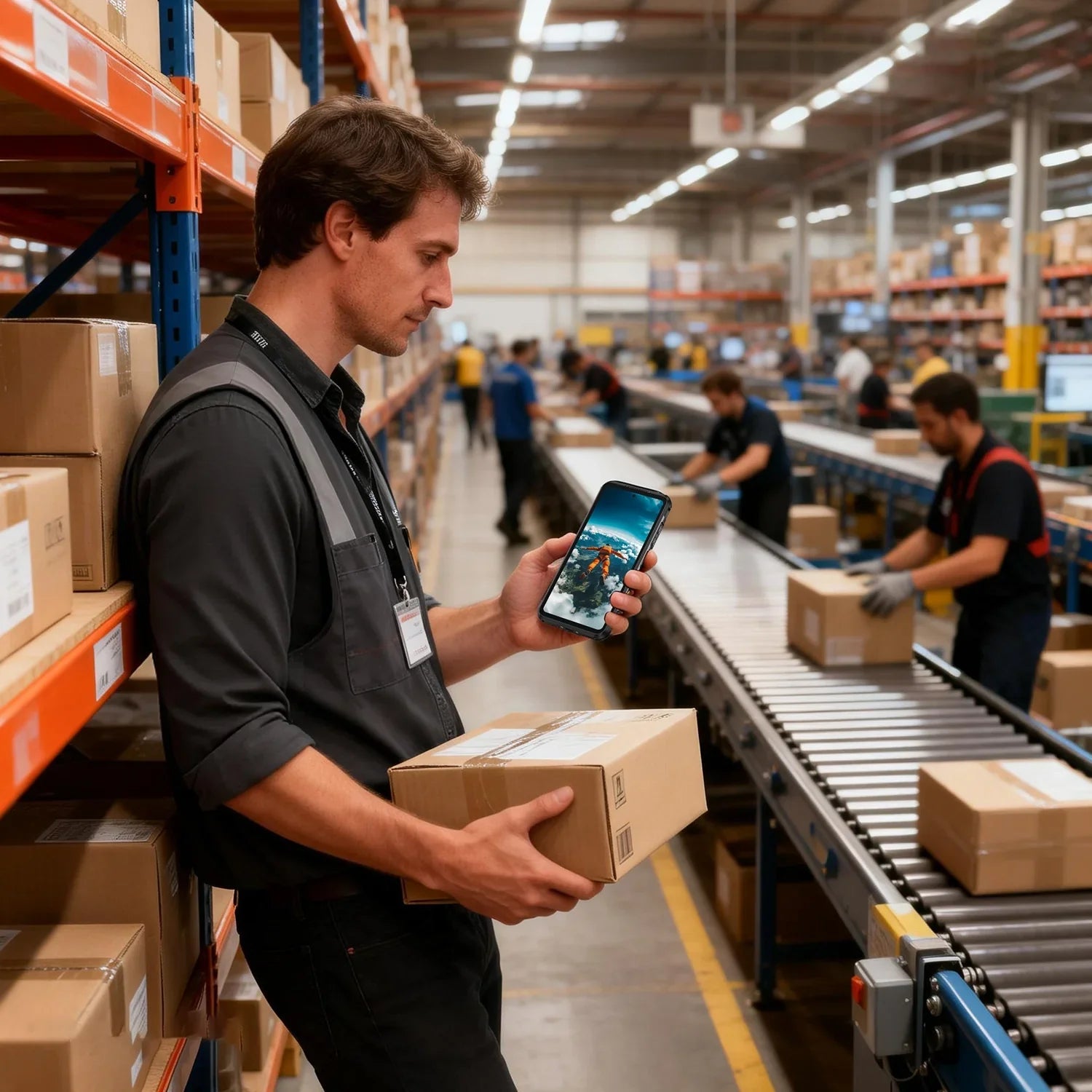
For couriers, food delivery riders, and warehouse operators, the smartphone is no longer just a communication device—it is the Core Productivity Tool. It handles barcode scanning, GPS navigation, e-signatures, photo proof-of-delivery (POD), and real-time dispatch communication.
Yet, the real-world logistics environment is brutal:
-
Uncontrollable Weather: Wet-hand operation in heavy rain, automatic shutdowns in freezing winters, and overheating on dashboards during summer.
-
High-Intensity Physical Impact: Drops from sorting lines, vibrations from motorcycle mounts, and collisions inside cargo vans.
-
Complex Contaminants: Oil, dust, and the frequent need for alcohol disinfection.
In this environment, a device needs more than just processing power; it needs Survivability.
2. The Core Problem: Why Consumer Smartphones Fail
We must admit that mainstream Consumer-grade Smartphones are precise, elegant pieces of art, but they are not designed for high-intensity industrial scenarios. In logistics, ordinary phones typically face these failure points:
-
Structural Fragility: Glass backs and narrow bezels shatter easily upon impact. Even with a case, internal motherboards can suffer from solder joint detachment due to high-frequency vibrations (e.g., on a motorbike).
-
Thermal Throttling: When navigating under direct sunlight, consumer phones often overheat, dim their screens, or shut down. Conversely, in -20°C cold chain warehouses, lithium-ion activity drops, causing battery percentages to "nosedive."
-
Touch Logic Limitations: Capacitive screens often become unresponsive or register "ghost touches" when wet or used with gloves. This forces drivers to remove gloves or dry the screen, severely slowing down delivery efficiency. In practice, this means missed scans, delayed confirmations, and sometimes an entire route falling behind schedule.
This isn't just about repair costs; it's about the invisible losses caused by Operational Downtime.
3. The Solution: Re-engineering for the Field
Rugged Phones are not simply "phones with thick cases." They represent a systemic engineering overhaul, from PCB layout to chassis materials. Designed for logistics, their logic includes:
-
Reinforced Chassis: Utilizing aluminum-titanium alloys or high-strength injection molding with Corner Buffers. Passing MIL-STD-810H standards ensures kinetic energy is effectively absorbed during drops.
-
Environmental Adaptability: Going beyond IP68 to meet IP69K standards means the device withstands not just water immersion, but high-pressure, high-temperature water jets—crucial for devices that need regular washing.
-
Optimized HMI (Human-Machine Interface): Retaining physical buttons. When wet hands or gloves make touchscreens fail, physical buttons are the ultimate fallback.
4. The RugOne Practice: Engineering Solutions for the "Last Mile"
As an explorer of industrial solutions, RugOne does not just stack specs; we focus on solving "on-site problems." Here is how RugOne approaches some of the most common logistics pain points:
-
Customizable Side Keys & PTT (Push-to-Talk):
We introduced programmable side keys. For logistics staff, complex flows like "Unlock -> Open App -> Click Scan" are simplified to "One-Press Access." A courier can activate the scanner or intercom by muscle memory, saving a few seconds each time—no unlocking, no app switching, no missed taps.
-
Glove Mode & Wet Touch:
RugOne optimizes touch IC algorithms. Whether delivering food in the rain or moving heavy cargo with non-slip gloves, the screen accurately recognizes commands without needing to be wiped dry.
-
Wide-Temperature Battery Technology:
For cold chain and winter operations, RugOne uses low-temp resistant battery formulas, ensuring stable voltage output even at -30°C, eliminating the "battery drain" anxiety.
5. Scenario Comparison: Consumer Phone vs. Rugged Phone
| Operational Scenario | Consumer Smartphone | Rugged Phone (e.g., RugOne) | Operational Impact |
| Rainy Delivery | Screen jumps/unresponsive; can't click "Confirm." | Wet Touch Mode ensures precision. | Avoids late orders. |
| Drop (1.5m) | Screen shatters; requires repair; downtime. | Intact due to buffers; pick up and use. | Zero downtime. |
| Continuous GPS | Overheats/dims in summer; battery drains fast. | Better thermals; High-capacity battery lasts all day. | Reduces range anxiety. |
| Ease of Use | Requires two hands; reliant on touch. | Physical Keys support blind operation. | Boosts efficiency per order. |
| Cleaning | Wipe only; fear of water damage. | Wash with soap or submerge directly. | Hygiene compliance. |
6. Operational Value: Calculating the TCO
Fleet managers often focus only on Initial Purchase Cost. However, if we look at TCO (Total Cost of Ownership), the math changes.
While a rugged device like RugOne might have a higher upfront cost than a budget Android phone, over a 2–3 year lifecycle:
-
Lower Repair Rate: Drastically reduced screen replacement costs.
-
Higher Asset Availability: No idle capacity due to devices sitting in repair shops.
-
Efficiency Gains: Seconds saved per order accumulate into significant potential daily volume.
Conclusion: In the high-intensity battlefield of logistics, a consumer phone is a "consumable," while a rugged phone is a "fixed asset."
7. FAQ
Q1: Why should logistics operations use Rugged Phones?
A: Logistics environments involve rain, vibrations, and drops. Rugged phones (like RugOne) are MIL-STD-810H and IP68/IP69K certified, significantly reducing damage rates, supporting glove/wet operation, and offering longer battery life, which lowers Total Cost of Ownership (TCO).
Q2: How do rugged phones improve courier efficiency?
A: Through engineering optimizations like Programmable Physical Keys (for one-click scanning/PTT) and High-Capacity Batteries. These features eliminate the need to repeatedly wake screens or charge mid-shift, saving time on every delivery.
Q3: What is the difference between IP68 and IP69K for logistics?
A: IP68 protects against submersion (typically 1.5m water). IP69K protects against high-pressure, high-temperature water jets. This is critical for devices used in food or medical logistics that require frequent sanitization or washing.
Q4: Is RugOne suitable for warehouse scanning?
A: Yes. RugOne combines drop resistance (for concrete floors) with cameras optimized for barcode recognition. Paired with custom side keys, it can replace expensive dedicated PDA scanners for many tasks, For many workflows, it reduces the need to carry a separate dedicated scanner.