 Xsnap 7 Pro
 Xever 8
 Xever 7 Pro
 Xever 7
 Xlink 7
 Charging Station (Xever 8 Series)
 Charging Station (Xever 7 Series)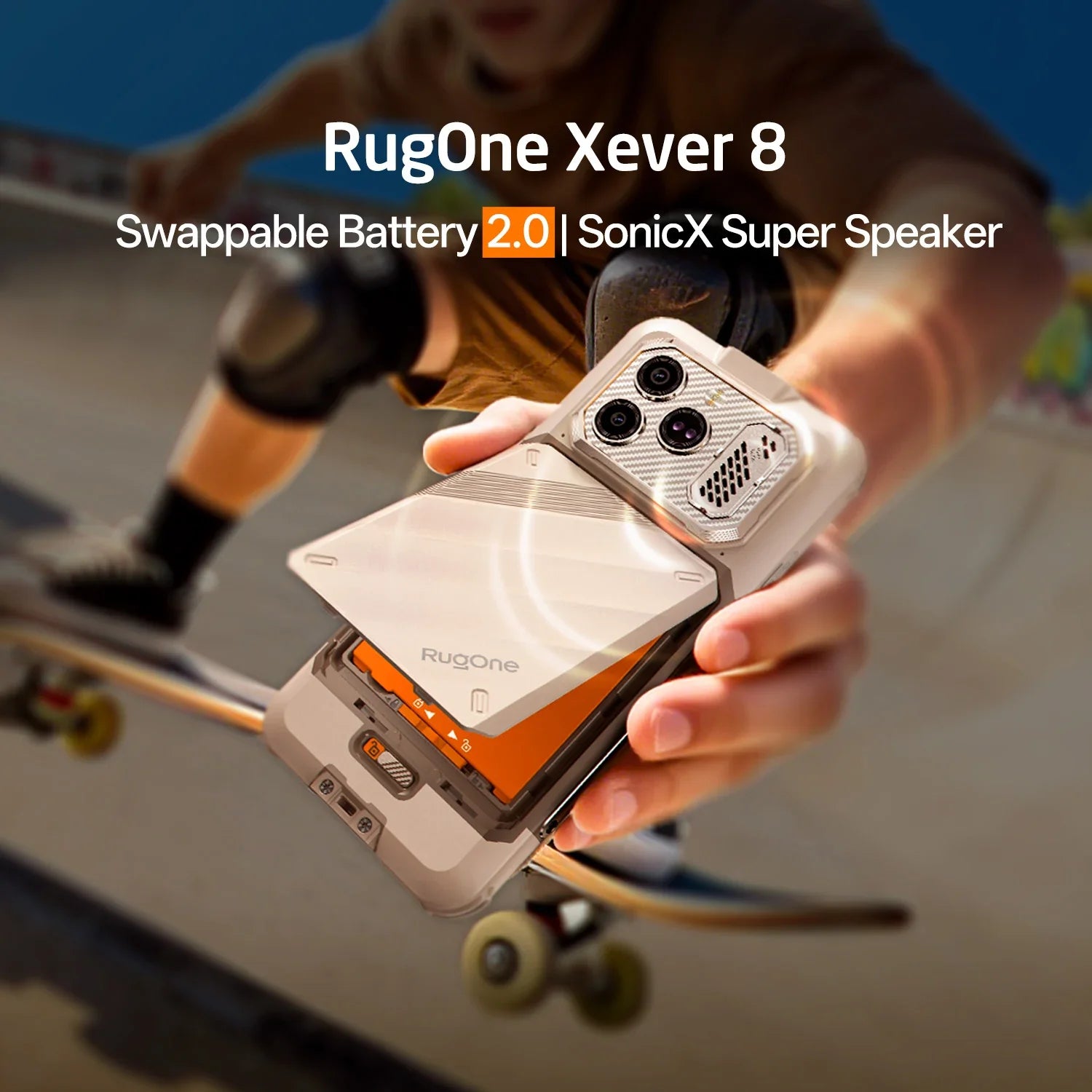
 Our recent launch of the RugOne Xever 8 has sparked a lot of excitement, particularly around its headline feature: Swappable Battery Technology 2.0. But how does a phone stay fully active with its battery completely removed? How is this different from the Xever 7? Let’s dive into what makes this zero-downtime power system a reality.
Evolution: Xever 7 vs. Xever 8
To appreciate the leap forward in version 2.0, it helps to look at where we started.
When you swap the battery on the Xever 8, the entire process is designed to be completely imperceptible to the device's operation. On older generational systems like the Xever 7, removing the battery required the phone to enter a "Hibernate-to-Swap" state, which meant the screen went black, media paused, and your active tasks were temporarily frozen in place while the system waited for a new power source.

With Swappable Battery 2.0 on the Xever 8, that friction is entirely gone. The transition is live and instantaneous. As you physically pull out the depleted battery, the display remains fully illuminated and responsive to your touch. If you are in the middle of a phone call, the line stays crystal clear without dropping or putting the other person on hold. If you are streaming a video or listening to music, the media continues playing smoothly without buffering or interrupting your experience. Apps stay completely active, and web pages do not refresh, meaning your digital workflow remains entirely untouched from the exact moment you remove the old battery to the moment the new one clicks into place.
The Engineering: How Does It Stay On?
The magic behind Swappable Battery 2.0 comes down to a sophisticated dual-source power management architecture.
Inside the Xever 8, the main 4,800mAh removable battery doesn't act alone. It works in tandem with an internal, ultra-efficient Bridge Power Cell built directly onto the motherboard.
When you release the outer latches, a specialized hardware sensor instantly signals the power management integrated circuit (PMIC). Within microseconds, the PMIC shifts the entire operational load to the Bridge Power Cell.
Because this internal cell is optimized for rapid, high-current discharge, it provides enough temporary current to keep the 6nm MediaTek Helio G200 processor, the 120Hz display, and the cellular antennas fully operational. Once you snap the fresh 4,800mAh battery back into place, the PMIC seamlessly hands the load back to the primary battery and immediately begins trickling power back into the internal bridge cell so it’s ready for your next swap.

Redesigned for the Wild: The Dual-Layer Latch System
Keeping a phone powered on during a manual swap is a software and electrical engineering triumph, but keeping that battery secure during a 2-meter drop onto solid rock is a mechanical one.
A swappable battery inherently introduces a structural challenge: if the phone impacts the ground, inertia can cause a heavy battery to burst through its housing. To prevent this, we abandoned traditional clip-on plastic covers and developed our Dual-Layer Hardware Latch System:
The Primary Battery Latch: This internal mechanism locks the core 4,800mAh cell directly into the chassis frame. Even if the outer door is open, the battery cannot wiggle free from its pin connectors.
The Battery Cover Latch: A heavy-duty, reinforced exterior deadbolt that seals the outer door. This dual-action mechanism compresses the rubberized gaskets tightly enough to maintain the phone's extreme drop resistance.

Why "Zero-Downtime" Changes Everything
For casual users, a 30-second reboot is a minor inconvenience. But for the Xever 8's target audience—hikers, field engineers, search-and-rescue teams, and extreme outdoor athletes—downtime is a vulnerability.
Continuous GPS Tracking: A phone reboot can cause GPS drift, forcing you to wait for the device to re-acquire satellite locks deep in canyon terrain. With Hot-Swap 2.0, your coordinates never drop.
Critical Communication: If you are managing a remote team over a live call or coordinates stream, you don't have to say, "Hang on, shutting down to swap batteries." You just swap and keep talking.
Uninterrupted Media: If you're using the Xever 8's massive SonicX Super Speaker to power an outdoor camp gathering at 117dB, the music doesn't stop just because the battery did.

The RugOne Xever 8 isn't just a phone with a removable back; it is a meticulously engineered piece of survival gear designed to make sure your link to the digital world is completely unbreakable.